A partially filled water tank can turn a routine haul into a serious safety risk.
The danger peaks when the tank sits around the halfway mark. This is when water is free to shift and create momentum inside the truck. That internal movement can quickly destabilize a vehicle, especially during sudden stops or sharp turns.
This is a “worse-case scenario from a safety standpoint,” notes Josh Swank of Philippi-Hagenbuch Inc., “because that water likes to move.”
Josh outlines how contractors can reduce risk while also improving operational efficiency on the jobsite.
Optimal tank design is critical to prevent water surges during braking or turning, especially when tanks are partially filled.
HOW TANK DESIGN IMPROVES SAFETY AND STABILITY
To improve safety risks, it is critical to understand that the design of the tank itself plays a major role in controlling water movement.
Optimal tank design is critical to prevent water surges during braking or turning, especially when tanks are partially filled. Contractors should look for tanks with built-in safety features that reduce internal movement.
For example, holes in a tank’s baffling system can help reduce the force of moving water, lowering the risk of instability or tipping. Anti-surge stabilizers on newer trucks can further improve safety, while baffling systems that close and lock in place help contain movement from front to back and side to side.
Lowering the tank’s center of gravity through mounting systems that align with the truck chassis can also improve stability.
Newer tanks may also include external and internal access doors that allow air and light into the tank, reducing bacteria buildup and creating a safer, more comfortable maintenance environment. Full-sized internal doors enable workers to walk inside the tank instead of crawling, improving safety during inspections and cleaning.
WHY WATER TANKS ARE ESSENTIAL ON THE JOBSITE
Understanding why water tanks are critical in the first place is an important factor in keeping workers safe.
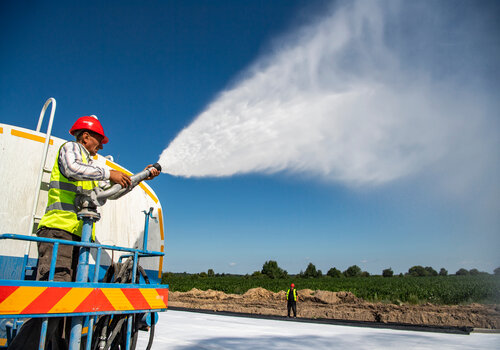
Contractors must spray water on haul roads, stockpiles and other jobsite areas to minimize airborne dust and dangerous particulates like crystalline silica. This not only maintains visibility, but also protects workers’ health, as long-term exposure can lead to serious conditions including chronic obstructive pulmonary disease and lung cancer.
“No company wants to put their workers and their clients in harm’s way,” Josh says.
Complications from inhaling these particulates can also lead to increased absenteeism, higher health-related costs and a greater risk of citations from regulatory agencies. When dust levels rise too high, operations can be shut down entirely.
HOW TO IMPROVE WATER APPLICATION EFFICIENCY
Once water is on site, how it’s applied can make the difference between effective dust control and wasted resources.
Spraying water in the morning allows it to last longer as temperatures rise, reducing overall usage. However, applying too much water at once can oversaturate haul roads, creating unsafe driving conditions and wasting material.
Multiple factors contribute to efficient water application. It is important to be aware of each step of the process.
Best Practices Include:
• Apply water early in the day to reduce evaporation
• Reapply smaller amounts consistently instead of overwatering
• Avoid oversaturating haul roads, which creates safety and cost issues
• Adjust spray heads to minimize atomization and improve dust capture
• Monitor weather and road conditions to fine-tune application rates
HOW AUTOMATION IS CHANGING WATER MANAGEMENT
As jobsites push for greater efficiency and control, technology is adding another layer of precision to water tank operations.
Autonomous water distribution systems, particularly those integrated with autonomous haul trucks, are being used to solve safety concerns before they become a problem.
These systems can include programmable controls, GPS-enabled monitoring and sensors connected to air quality systems that alert operators when dust levels rise.
Contractors are also pairing these systems with telematic dashboards to track water usage, application rates and refill cycles. This helps crews quickly spot overwatering or missed areas and adjust in real time.
“Whether or not you use autonomous trucks, planning for the future is key,” Josh says. “So whatever water tank you’re buying now, make sure you can use it in 15 years.”
At the end of the day, all aspects of water management – from delivery to application – involve decisions that affect safety outcomes. The more control that you have over how water moves in the tank and on the jobsite will lower the risk to both equipment and, most importantly, your workers.
Josh shared these insights about Reducing Silica and Dust with Efficient Water Tank Use at CONEXPO-CON/AGG 2026. Purchase On Demand Education Access to listen to recordings from the show.
PHOTO CREDIT: SHUTTERSTOCK/PAPARAZZZA