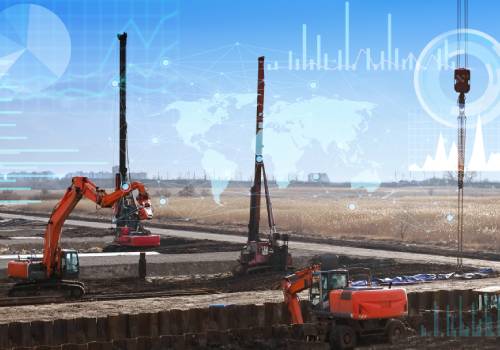
For years, construction has lagged other industries in automation; not because of a lack of interest, but because of the environment itself. This is especially true in complex excavation work.
Every scoop of an excavator bucket is different. A site might move from soft sand to dense clay to buried rock within seconds. The machines themselves add another layer of difficulty. Two identical models can behave differently due to wear, temperature shifts and friction, making them hard to model and control.
Traditional automation struggles in these conditions. Most systems rely on predefined paths and predictable inputs, which is something a construction site rarely provides.
Gravis Robotics, the 2026 Next Level Award winner in the technology category at CONEXPO-CON/AGG, has developed an adaptive, data-driven system that makes automation possible across all earthmoving jobsites.

Operators remain central to the process. Rather than replacing them, these systems are designed to enhance their capabilities.
WHAT’S CHANGING: A SHIFT TO ADAPTIVE INTELLIGENCE
Instead of trying to force construction into rigid automation models, Gravis Robotics has created a new generation of systems that take a different approach: teaching machines to adapt like humans.
Using AI-powered robotics, real-time sensing and large-scale simulation, these systems are designed to learn from experience and adjust just like an operator would.
The goal isn’t to follow a fixed path. It’s to continuously respond to what is happening in the moment.
“An operator who's driven that machine for 20 years, they understand when to let go of that stick because they know just when that machine's going to start slowing down, and that changes depending on what's going on with the bucket,” Gravis Robotics CEO and Co-Founder Ryan Luke Johns says.
The adaptive, data-driven system learns from real-world operation with 3D sensing, onboard computing, networking and cameras. In the cab, the system acts as a copilot, providing real-time cut/fill visibility, analytics, augmented reality guidance and people detection.
The platform enables autonomous tasks such as trenching, bulk excavation and truck loading.
HOW IT WORKS ON THE JOBSITE
Using LIDAR and onboard sensors, an excavator with the Gravis Rack continuously scans its surroundings. It is understanding how every rock settles and is doing what a human does. It thinks about the stability of the structure and replans.
The technology builds a live 3D model of the environment and updates it constantly as material is moved. Companies can build an efficient simulation model that lets them run thousands of machines in parallel to train them much faster than running them in real time.
One key metric is bucket fullness. The system learns what actions lead to fuller buckets and faster cycles, and it optimizes those outcomes. That allows the machine to make better decisions in the field.
Ryan compares it to “thousands of operators’ lifetimes of experience.”
WHAT OPERATORS ACTUALLY EXPERIENCE
Operators interact with the machine through a tablet interface that provides a real-time view of the jobsite, including:
- Live 3D terrain mapping
- Progress tracking and target grades
- Highlighting obstacles and underground utilities
- Multiple camera and sensor views
Some systems even offer augmented reality overlays, showing operators exactly where to dig and what has already been completed. Maps are color-coded based on required fill.
In challenging situations, operators can take control. Joysticks and pedals can plug into the tablet via USB. No large onboard system is required. Operators remain central to the process. Rather than replacing them, these systems are designed to enhance their capabilities.
“The value of autonomy is not removing labor,” Ryan explains. “It's about making that labor do more.”
THE IMPACT: MORE CONSISTENT, PREDICTABLE WORK
This portable technology is designed to scale with the operator. Crews can start in the cab and, as confidence grows, transition to remote operation or even manage multiple machines.
As autonomy improves, the need for manual intervention drops and productivity rises. Operators also spend less time in hazardous environments.
A real-life example comes from a South American contractor who laid 60 miles of pipeline through dense ground and shallow bedrock using autonomous machines to adapt to changing conditions and maintain progress. The result: productivity gains of around 30%.
THE BIGGER PICTURE: HUMANS AND MACHINES
The challenge hasn’t changed; excavation is still unpredictable.
What’s changing is the response. As experienced workers retire, adaptive automation is helping bridge the gap by improving safety, consistency and productivity.
Operators remain central, with technology designed to support how they work, not replace them.
“We want to enable fluidity of use that lets people use this in their own way,” Ryan shares.
See the latest construction innovations in action. Watch the Next Level Award ceremony and other CONEXPO-CON/AGG 2026 Ground Breakers sessions—free on demand.
PHOTO COURTESY CONEXPO-CON/AGG