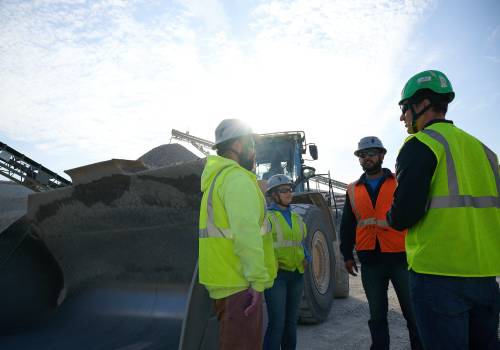
At 6:45 a.m., a supervisor gives quick instructions before the start of a shift. The crew nods and gets to work.
By mid-morning, the work isn’t done as expected. The instructions were clear. So why didn’t they stick?
“Different people have different expectations, different understandings,” said Kim MacDonald, a psychological health and safety consultant and founder of 13 Factors for Business Growth.
Without a clear understanding of how communication is used in the moment, breakdowns happen across jobsites.

When these factors stack up, workers default to what feels safest: staying quiet, sticking to familiar patterns or assuming they understand the task.
THREE TYPES OF COMMUNICATION
Kim MacDonald breaks workplace communication into three types:
- Linear: One-way instructions with little to no feedback
- Interactive: Back-and-forth clarification
- Generative: Both sides actively build shared understanding
Most jobsites default to linear communication where instructions are given quickly, crews acknowledge them and work begins. But alignment is assumed without ever confirming it.
Interactive communication checks what was said for clarity. But that’s still not enough to avoid problems.
It’s generative communication that prevents breakdowns. This is when both sides take a moment to confirm not just what was said, but what was understood.
COMMUNICATION SHAPES PSYCHOLOGICAL SAFETY
When crews work off different interpretations of what was said, the consequences can eventually go beyond communication to affect psychological health and safety.
Psychosocial risks can create stress that affects decisions. National Institutes of Health (NIH) research shows that acute stress moves the brain away from deliberate processing and toward faster, assumption-driven responses. On a jobsite, that shift can turn straightforward instructions into something very different by the time it’s put into action.
Psychological safety shapes what happens next. When workers don’t feel comfortable asking questions, admitting confusion or slowing the crew down, they stay silent. That silence forces gaps to be filled with assumptions and keeps any mental wellness issues hidden.
Bias adds another layer. Crews often assume a familiar coworker “already knows” what to do, or they hesitate to clarify instructions with someone they perceive as more experienced. Those moments of hesitation or overconfidence create gaps that get filled with interpretation rather than shared understanding.
When these factors stack up, workers default to what feels safest: staying quiet, sticking to familiar patterns or assuming they understand the task.
This sets the stage for operational, safety and mental breakdowns.
A PRACTICAL SHIFT: FROM REACTING TO ASKING
Once crew leaders understand how quickly communication breaks down under pressure, the next step is changing how conversations happen in the moment.
Most breakdowns come from reacting too quickly and assuming alignment.
But by asking key questions, leaders can slow things down just enough to surface what’s happening in that moment.
That shift can be simple:
- Instead of correcting immediately, ask what the worker is seeing
- Instead of repeating instructions, ask how they’re interpreting them
- Instead of assuming progress, ask what might get in the way
This approach reinforces psychological health and safety. When leaders show they’re willing to ask before reacting, workers are more likely to raise concerns early, share what’s getting in their way and speak up.
WHAT TO DO DIFFERENTLY ON THE NEXT SHIFT
You don’t need to overhaul how your team communicates. You need to adjust how key moments are handled, especially when the pressure is on.
A few small shifts make the biggest difference:
- Pause before reacting when something goes wrong
- Ask one question before assuming
- Be specific about what needs to happen and when
- Check for understanding, not just acknowledgment
These simple changes create space for better information to surface. They also reinforce psychological health and safety by making it easier for workers to speak up, clarify expectations, and flag issues early.
Editor’s Note: This is the third part of our Mental Health series. Read part one and part two for additional ways to support your workforce.
May is Mental Health Awareness Month. Learn how CONEXPO-CON/AGG is Taking Mental Health to the Next Level. If you or someone you work with needs support, the 988 Suicide & Crisis Lifeline is available 24/7.
PHOTO CREDIT: SHUTTERSTOCK/SUPAVADEE BUTRADEE