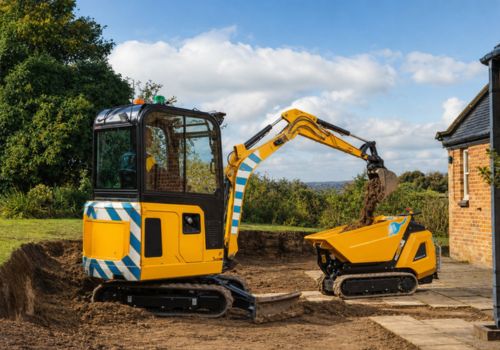
A contractor signs off on a new battery-electric backhoe, ready to cut fuel costs and meet a client’s emissions target. The machine shows up ready to work. Then the crew asks the question nobody planned for: Where does it charge?
That gap between owning electric equipment and powering it is where most BEV plans stall. The machine can do the work. Keeping it charged is what most contractors underestimate.

Successful BEV adoption depends on more than the machine. Power availability, charging windows, and duty cycles decide whether electrification actually works on your jobsite.
WHY THE CHARGER MATTERS MORE THAN THE MACHINE
Battery-electric equipment has matured fast. Off-highway machines now handle the high torque and rough conditions construction demands, and energy density has climbed enough to make full shifts realistic on many duty cycles.
The hardware is no longer the limiting factor. The bigger problem now is getting enough power to the machine.
Most jobsites were never wired for the loads an electric fleet pulls, and the problem changes shape depending on where the work happens.
Preston Moore of John Deere frames jobsite power as a spectrum. At one end sits the ideal, which is a grid-connected site with infrastructure for fast charging — but the reality is that most contractors will not be working in ideal site conditions.
WHERE THE GRID RUNS THIN
The middle of that spectrum is what Preston calls grid-constrained: power reaches the site, but it was never built for industrial machines. Preston points to the questions that decide readiness. Can the transformer on that line support DC fast charging? Can it handle a fleet’s load, or must the contractor invest first?
Then there is the far end, where the grid runs out. Picture a road-building crew: a linear jobsite that moves with the work, zero grid access, equipment stored on site overnight. That is the off-grid reality, where the conflict shows up sharpest: high power demand meeting low or no site power.
These sites often have little or no utility access, and securing permanent service can take months and cost enough to erode the savings electrification is meant to deliver. Mobile, scalable charging solutions, including trailer-mounted units and battery storage, help keep machines productive even where the grid cannot reach.
DUTY CYCLES DECIDE EVERYTHING
Contractors first need to understand what a machine needs to accomplish during a full day of work before they can determine power requirements.
“When we think about getting a job done with the vehicle, how much energy are we using? How much charge time do I need?” Preston says.
A machine running hard for eight hours straight has vastly different needs than one that idles between bursts of work. Duty cycle drives how much energy the machine uses, how fast it recharges and how much downtime charging will cost. A crew with a 12-hour overnight window can lean on slower charging, while a machine that only stops for lunch needs power fast enough to recover.
If the real-life worksite requirements are wrong, then the math falls apart. Undersize the setup and machines sit idle waiting for power; oversize it and you have paid for capacity you never use. Telematics help, since equipment data shows how the fleet operates and lets a contractor size charging to real demand.
Electrification should be treated as an operational commitment that extends well past the initial purchase. Here are some important points to consider:
- Where you sit on the grid. Grid-connected, grid-constrained or off-grid shapes everything else.
- Charging windows. How many hours fall between shifts, and can the machine fully recharge in time?
- Duty cycle reality. How hard does the machine work, and how much energy does that demand?
- Total cost of ownership. Account for energy costs, incentives and peak demand charges, not just the sticker price.
THE REALISTIC PATH FORWARD
Electric equipment has a place on construction sites. The off-grid road job that looks impossible at full fleet scale might be worth it for the right machine on the right task.
“Small-scale road repair, that could very much be a case where an electric vehicle could do the job,” Preston says.
The contractors who succeed plan the power before they buy the machine. Site assessments, right-sized infrastructure and a realistic read of duty cycles separate a working electric fleet from one parked waiting to charge.
The machine is ready. The real question is whether the jobsite is.
Preston Moore shared insights on BEV charging during the CONEXPO-CON/AGG 2026 session, The Missing Link: Charging Infrastructure and BEV Adoption at the Edge of the Grid. Watch the full session by purchasing On Demand Education Access.
PHOTO CREDIT: SHUTTERSTOCK.COM/SCHARFSINN