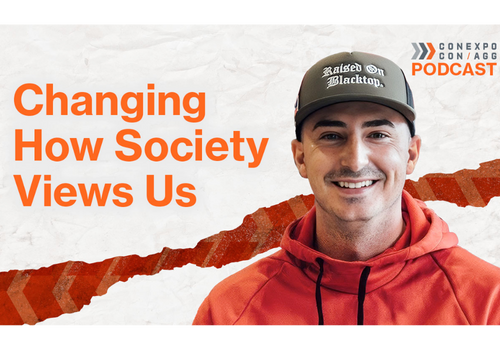



Raised on Blacktop’s Matt Stanley returns to explain how a family paving business actually runs. Most people think a large fleet means the owner is comfortable, but the truth is that the work feels fragile when you are in the trenches every day, and you have to ‘keep the main thing the main thing’ to stay profitable. Matt reveals how to grow a public brand without losing touch with the job site.
Explaining that you need to master the balance between field leadership and scaling systems, Matt reveals how to earn respect on the job while stepping back to let the company grow. He also talks about the mental toll of content creation and how he’s working to change that. Get ready for a very real conversation about the hard truth behind the highlight reels.
Topics:
- Hiring vs retaining crews
- Leading from the jobsite
- Letting go of micromanagement
- Redefining success and burnout
Watch now:
Listen now:
Listen on your favorite app: Apple Podcasts | Spotify | YouTube
Subscribe to the CONEXPO-CON/AGG YouTube channel to be notified of new episodes.
Join more than 65,000 industry peers who receive construction industry news and trends each week. Subscribe to CONEXPO-CON/AGG 365.
Episode transcript:
Taylor White: Welcome back, everybody, to the CONEXPO-CON/AGG Podcast, brought to you by our good friends over at John Deere Power Systems. I am your host, as always, Taylor White. I do want to remind everybody that the code "PODCAST20" is still valid. Share it. March 13th through the 17th in Las Vegas. There will be over three million square feet, thousands of exhibitors, and thousands of attendees. We want to make sure that everybody is out there, so use the code "PODCAST20." You won't be able to do that forever, so please go do that now.
With that being said, today I have somebody with me who has started a massive brand and a family owned operation as well: a paving company. He has been on the podcast before. Matt Stanley, thank you for coming on today.
Matt Stanley: Thank you for having me, Taylor. This is my third time now.
Taylor White: Yeah, this is number three. People always ask to have you on, man. You create a large voice on the internet, and people love hearing what you have to say.
Matt Stanley: Thanks. I am honored to hear that. Just before we got on the call, I was thinking back to the first time I did this with Missy. I might have said this last time we did it, too, but I was so freaking nervous. I was probably in my early 20s. I did it on the job on my phone. There were backup alarms in the background. I think you get a little butterflies every time you get on a podcast, but I laugh looking back. Thank you for having me.
Taylor White: Yeah, man, I am pumped that you are here. Because you have been on here three times, that was the direction I wanted to take it. I want to frame the conversation a little differently than most. This isn't an "origin story" episode. It's not about the highlight reels. What I am interested in is what breaks as a business grows: the systems, the people, or even the operators themselves. Also, on top of that, I know that you are going to be able to speak to a lot of this because of the evolution of a paving company over the years, running a public brand, and it also being a family owned operation with a lot of chefs in the kitchen. To start things off, I would love to know: what part of the business appears solid from the outside but is still very fragile behind the scenes?
Matt Stanley: That’s a great question. I’m going to go a little broader with this and say that while the business is very well run, and anyone we work for is in shock at what a well oiled machine we are, I think most business owners or contractors will connect to this: it all feels fragile when you’re in the trenches. I think that’s why it’s so important for us to show up every morning. There is a demand to perform every day. Maybe it is because of our DNA coming from a small family shop, but every job is important.
I talk about this with my brothers all the time. Sometimes the most difficult jobs go seamlessly, and then on the easy jobs, a chain can snap on a paver or you get a hydraulic leak. Then it looks like it is amateur hour again. I would say the more I get into everything, and the bigger the companies we work for, nobody has a full handle on anything. We just try to do our best every day, man. It sounds so cliché, but it’s really all you can do. At the end of the day, I’m not the business owner. I’m not the guy crunching numbers behind the computer. I’m a paver operator, and my job is to put the best product out I can and keep our guys happy.
Taylor White: What is the evolution from where you have been to where you are now? What do the next ten years look like for you specifically within the business?
Matt Stanley: Yeah, for anyone that doesn't know us, my dad started this business with a one-ton truck and a couple of tools on the back. We’ve grown into roughly 30 trucks, including tool trucks and tri-axles, and about 40 pieces of equipment. We have grown quite a bit. Our scope of work has changed from doing residential work to small commercial work. Now, our bread and butter is big commercial work, town municipalities, and city contracts.
I think anyone in a family business can connect to this: when someone asks me where I’m going to be in five years, I say, "Wherever I need to be, really." Things can happen. I'll be wherever the family and the business need me. But in the next ten years, as I talk about with my brothers, we will cement ourselves in our roles a little bit more and have our own avenues. We sort of do that now. One of my brothers mainly runs the milling crew and the milling operation. My other brother, Josh, mainly runs the paving operation. I’m his second-in-command, and I'm proud to say it. Sometimes I’m the utility guy going back and forth. I don’t know if we’ll have a whole other operation going on one day. Whatever it is, I really don’t know. That’s kind of the beauty of it and what keeps you on your toes. I don’t really have a solid answer for that, but we roll with the punches.
Taylor White: That is a solid answer. Like you said, the best thing to say is "wherever the business needs me." I think that’s a fantastic way to answer it because that’s essentially what every business owner does, too. I don’t pretend like I’m crunching Excel spreadsheets and doing my end-of-the-year taxes. We have an accountant who does that. Where my business needs me is making sure that we have cash flow coming in through the wintertime, because that’s very important for us.
Matt Stanley: Making sure that board is full, right?
Taylor White: Yeah, exactly. And not just with scribbles from my daughter.
Matt Stanley: Not to cut you off, but one thing I wanted to add was something my brothers and I talk about a lot nowadays. You mentioned the next ten years and where we want to take this company. Growing up, we had big dreams, and my dad still has big dreams for what we want to do. For a paving company, the end-all be-all is paving highways and airports. That is what the big guys are doing.
The deeper we get into these city contracts, state work, and prevailing wage, you kind of see why my dad shied away from this stuff. The paperwork is intense, and the restrictions are everywhere. Since this is the CONEXPO-CON/AGG Podcast, I'll say that when I go to these shows, or even our World of Asphalt show, it is great to connect with guys like you because we are the same person. Being on social media, you get to know these other companies, and you see them at these trade shows. I love pulling an old-timer to the side and asking, "What would you do differently?" They own these big companies, and a lot of them say, "I wouldn't have 100 employees." They ask what we do in a year, and when they hear we have 20 employees, they say, "That seems like a sweet spot." Gaining that retrospect and seeing where you want to go is pretty important.
Taylor White: I totally agree. I have this conversation a lot, too. My father took the business to where he wanted to take it, and then for the past five years, I’ve taken it to where I needed to take it with the team. I always tell people that I’m excited to see where the next generation will take it, because I don’t know where that "tap out" point for me is. That’s kind of what you’re talking about: having this many people, being this profitable, and having a big office and shop. Every generation can keep adding to it. That is key. I think of how much stress goes on right now at the size we are, and I think, "Holy God, if we double that, I don't know if I want to do that."
Matt Stanley: Exactly. You want to be comfortable in the sense that you have a handle on things, but you don’t want to be so comfortable that you let your foot off the pedal and become a little lazy. I think that is in our DNA. We want to push the button. I see what you do online; you love pushing the envelope, and so do I. But you are a truck and equipment guy. You want to see 50 trucks sitting outside your shop, but that also means 50 services and 50 CDL drivers. It’s a lot. You gain respect for those big companies because that is such a big feat.
Taylor White: Everything definitely adds up. You’re never done learning. Another important part of what we’re talking about is leadership and crews. What do you find harder today: finding good people or keeping great ones?
Matt Stanley: Short answer: they are both challenging. I like to think that once we get an employee and get them into our culture, given our history, they tend to stay. Maybe finding good employees is more challenging. I’ve talked to Aaron Witt before, and he is big on workforce development. A company like ours has 20 to 25 guys. If we hire a couple of guys a year, that’s good for us. If we hire three, that’s a lot. Since the pool is small, we can kind of pick and choose when we want to add people. Does that make sense?
Taylor White: Yeah, 100 percent. But how are you keeping those solid 20 guys? What do you think keeps them there?
Matt Stanley: I’ll be completely honest with you: I think what keeps them there is that my parents are good bosses. We’ve got employees who have worked for us for 30 years, which is unheard of. I’m 33 years old, so they remember when I was in diapers. I’m also going to take a little credit for this. My brothers and I are there, we’re humble, and we’re on the job. Our boots are dirty, and we’ve got calluses on our hands. At the end of the day, employees like that. If one of us wasn't there, I could see how tensions would rise.
There is an unspoken hierarchy on the crews, which I think crews need. You have your laborers, your machine operators, and your foremen. My brothers and I are working foremen. It’s not that we’re better than them, but we’re in the trenches together. On those 100-degree days, we are there, too. Also, kudos to my father: he bounces around, and while he isn't breaking his back as much as he used to, he is down to do it. He loves it. When he hops from crew to crew, he gets out and sweats his shirt right through. He has three t-shirts in the back of his truck in the summer. I don’t like to see him doing that, but I see that my guys respect that. It’s hard not to be loyal to someone when they are loyal to you and they are right there beside you. I know it’s hard to scale if you are on the job all the time, but at the end of the day, it is super important to be a leader in construction. You have to know what is going on. You have to be there. We can call out the fluff because we know what it is.
Taylor White: I think that’s a really smart point. It is about respect. Your guys respect you because they see that you’ve done the work. We’re fortunate enough to have guys like that. I’m not out on-site every single day like I used to be, but a lot of the guys we have now saw me grow up through the ranks. They’ve seen me do it. If we’re shorthanded on a piece of machinery, or it’s weekend work and we can’t find guys, I am the first one to put my hand up and say, "I'll go tear down that house on the weekend and load trucks." It’s all good, man. I think that is a really important thing.
I remember doing a podcast with Aaron Witt back in the day. These guys at big companies with a thousand employees never see their bosses. It’s not hard to just show up every now and then to see them in the morning. As I’ve grown with the business and added a general contracting business where we are building for dealerships, my first meeting on Friday starts at 6:30 AM and I don’t have anything free until 3:00 PM. I was ignorant of just how busy you get when you start adding businesses and people. If you can master the culture, leadership, and respect of your employees while building the business at the same time, that is an unstoppable feat.
Matt Stanley: Yeah, which is extremely difficult.
Taylor White: So hard.
Matt Stanley: I love that you said that because you weren't necessarily wrong back in the day, right?
Taylor White: No, I just realized it’s not as easy.
Matt Stanley: You get that peek behind the curtain and you're like, "Oh, exactly."
Taylor White: A lot of the time, I am here at 6:00 or 6:15 in the morning. I come straight up to my office because that is my time. I have until 7:30 before other people start coming in. That is my time for invoices and catching up on emails until the phones start ringing and things start going on. It is hard, but you have to make that time. That leads me to my next question: what leadership habit did you have to unlearn as the company grew?
Matt Stanley: As far as my role in the company now, I see employees doing things sometimes where I think, "I would have done that differently." Now, I tell myself, "Don't say anything. Just let them do it." It’s not that it isn't coming out right; it’s still good. You just can’t micromanage. I still micromanage because we are perfectionists, but I'm not saying I'm perfect. There are things where I would have done it a different way, but when an employee says we should do it a certain way, I say, "All right, go do it. You've got it."
Taylor White: It’s a tough balance.
Matt Stanley: Yeah. They’ll say, "I want to do it this way," and even if it might be easier to do it another way, I let them go ahead. Maybe I'll put my two cents in afterward in a respectful way. It’s about dealing with different personalities. Some guys literally want an answer from you. That’s how I grew up. When I was super young on the job, if my dad wanted it done a certain way, I wanted to know exactly how he wanted it done, and then we would do it. That’s how we were trained. But some employees like to think for themselves, and you’ve just got to pat them on the back, say "good job," and that goes a long way.
Taylor White: How would you explain the balance between being respected versus being liked in a blue-collar environment? I struggle with this constantly. How do you balance being a friend versus being the boss who has to get things done?
Matt Stanley: We are a little fortunate, you and I, because we grew up around it. Your guys in higher positions might not be on the job, but the guys answering questions on the job respect you because you were there. I like to talk about this a lot: those years when you are 15 to 20 years old and you are really just a glorified employee, you are earning their respect. Those years are so golden. It comes down to treating them with respect. Can you repeat the second half of that question? I want to make sure I answer it.
Taylor White: How do you balance being respected versus being liked? Being a friend versus being the boss.
Matt Stanley: I think that is more about personality. You’ve got to have a good personality, but you also have to be able to be stern. It is about the delivery, which isn't always polished, especially in paving when it is 90 degrees out and I’m in over my head. I have reacted badly in situations. We’re blue-collar. I won't always say, "Taylor, I apologize for the way I reacted." It’s more like a slap on the back and saying, "My bad," and you keep going.
It's about admitting when you’re wrong. I’ll give you an example from the end of the year. In paving, we attack jobs differently then because the asphalt is getting cold. It’s harder to work in those conditions. In the summer, I can bring two guys on a compaction crew with two rollers and a whacker plate, and I don't have to worry about them compacting immediately. In the winter, it is a lot more stressful. We have to be extra detailed because things have to be rolled a certain way. I took my cousin aside, who is much older than me and works for us. I respect him a lot; he’s a hard worker. I was really mad at the rest of the guys on the crew. If I hadn't been in the right mental state, I might have flipped out on the whole crew. I've done it before, usually when I'm in over my head and something small happens. I just pulled my cousin aside and said, "Listen, if it wasn't the end of the year, I would totally flip out right now, but I want you to know I really appreciate your hard work." I hope that hit home for him: knowing that if I do flip out, it isn't on him.
Taylor White: That makes sense. Different situations and different things come up. You also don't always know what that person has going on outside of work. I want to shift gears a little bit and talk about "Raised on Blacktop." When that started, what problem were you trying to solve? Was it operational or cultural? Or was there no problem at all?
Matt Stanley: I just wanted to do something cool where I could use my creative juices. Five years ago, and even now, a lot of the talk in the trades is about the lack of workers. I don't think it's that the young generation doesn't want to work hard; I think it's society's view on the trades. I see it every day working on the road. People treat us like garbage. We’re in Connecticut, which is a high-dollar area. Most people are good, but you’ll get those one or two people who drive through your job site and say really disrespectful stuff. It always boiled my blood.
Part of starting the brand was about building something that showed the side I wanted to see: sick merch and sick videos. In reality, I wanted to bring more professionalism to the industry. It is actually helping the guys in the trades, but it’s also for people outside the industry. People around town all know the brand now, and when they drive past a paving job, maybe they have a little more respect for the paving guys or any blue-collar guy. I think society's view on construction deters people from going down this route. I feel it sometimes when someone talks to you like you’re dirt. If they only knew how smart my family is and how much blood, sweat, and tears we put into this industry. My family could do anything they wanted to, but we really like this industry. It isn't a dead-end job. You get that vibe from the average person, but it is so much more than that. I’m trying to shift society's view on the industry so that blue-collar guys feel as professional as they actually are.
Taylor White: I like that. That’s a good summary. At what point did it stop being an expression and start becoming a responsibility?
Matt Stanley: Pretty early. It started in my bedroom. I was selling t-shirts through Instagram DMs, and then I started the Shopify. Once LeeBoy approached me to do that special edition paving machine, things changed. We’ve sold roughly 300 of them. That was a lot of success early on. It was my north star, and it happened so quickly that it messed me up a little bit. I wondered what the next mountain was. I did well with that deal, and I still do.
If you think your brand is going to be on a leading manufacturer's door right out of the factory, you’d expect that to take ten years. When it happened, I thought I was going to be a millionaire. That wasn't the case, and it’s a good thing it wasn't, because I’ve learned so much about the other side of the industry. But once that happened, it put a stamp on the brand. People really look up to the brand, especially people around our age. I travel all over the world to meet supporters at trade shows. You have a responsibility to keep on the straight and narrow. It also reflects on American Pavement. We are that cool local company, but now we’re on a global scale. When we work outside of our regular radius, you’ve got a target on your back. We did a parking lot two hours away recently, and it didn't come out perfect because of tough conditions and nasty asphalt. I’m sure there were contractors coming by thinking, "I thought American did perfect work."
Taylor White: Yeah, people love to see you fail when you get to that size. I can totally relate to that. Locally and even with our competitors, people love to hear about your downfalls. Social media makes people think, "Those guys think they're so great."
Matt Stanley: They are just waiting for it to get to your head.
Taylor White: Exactly. What does "Raised on Blacktop" provide to American Pavement? Does it show up on a profit and loss statement? Is there a revenue stream that helps American Pavement land big jobs or clients?
Matt Stanley: I’m a humble guy, so I won't take all the credit, but our manufacturers treat us like gold now. Our local dealership is a relationship we’ve nurtured since the beginning when my dad was a nobody. They treated him fine then, but now it is VIP service. That helps a lot. We get parts delivered to the job even when the dealership is an hour away. We also get good discounts from manufacturers because of the brand we are building online.
"Raised on Blacktop" has also been a great bridge for us to connect with other paving companies. We created this brand for us and for them. It shows that we play nice. American Pavement is a big, badass company, but at the end of the day, I’m not just going to open up my books and show the next guy everything I’m doing. However, if I see another paving crew, I’m waving to them. Supporting other contractors shows that American Pavement plays nice. In paving, things are logistically difficult. We’ve had companies from over an hour away send us jobs and ask if we can do them. They probably wouldn't have reached out if they didn't know us through "Raised on Blacktop." It has bridged the gap and shown that we support our industry.
Taylor White: Has the public visibility boxed you into an identity that didn't match reality?
Matt Stanley: I try to make a point of being honest. I meet people at trade shows and get detailed questions on Instagram, and I tell people, "Listen, bro, I'm this person in the company. I don't know everything." As far as branding goes, I’ve had other contractors say they want to buy the merch but they weren't "raised on" blacktop. I tell them that isn't what it’s about.
I’ve had other opportunities pop up where I am not boxed in at all. I’ve sat down with restaurant owners to give them advice on social media. That could be an avenue I go down one day: starting a media company. People look at our success and want to recreate it. I’ve also had the opportunity to sponsor a race team for the Porsche America Cup. The owner of that company, Corporate Construction, builds high-end buildings. He wanted to get on social media, so we are going to sponsor the team through Raised on Blacktop. It’s a big investment, but it opens up avenues beyond just blacktop.
Taylor White: I love that you give advice to people. Do you find that some contractors try to build brands to avoid fixing broken systems? For example, if they aren't getting enough work, they think cool content will solve everything, when the real issue is that the work in the field isn't good.
Matt Stanley: Yes and yes. I see younger companies putting social media at the forefront when they really need to focus on the x’s and o’s a bit more. I wouldn't be doing this if I wasn't proud to show our work off. I think we have a good following because we keep the main thing the main thing. To keep the authenticity of the brand, it needs to happen gradually.
Taylor White: I agree. How do business disagreements change when family relationships are involved?
Matt Stanley: For us to expand our business in the next ten years, we have to get into highway and airport work. Usually, that involves night work. Buying that next big piece of equipment involves keeping it busy, which means night work. Night work can be hard on families. We did a good bit of it this year, and my brothers, my dad, and I had to ask if that is what we really want.
In the past, my dad shied away from those jobs because he didn't want his boys away from their families for two weeks at a time. If you’re tearing apart families, we don't want that. In a family business, the reality is often "work first, then family," but for the big decisions, it is family first. If you are going to be losing sleep and becoming a worse husband or father, it isn't worth it. We ask ourselves what time we want to get home when we get older. Do we want to be working until 8:00 PM every night? Decisions are more calculated now. When my parents started, it was about putting food on the table. Now that we are older and have our own families, and my parents have a dozen grandkids, we have to think about where we want to take the business.
Taylor White: What does success look like for you now?
Matt Stanley: Being happy and enjoying what you do. You and I both do content at a high level, and it is easy to overbook yourself and suck the fun out of it. I did that with my merch business. I used to ship everything myself. I would be working until 6:00 PM, then go to the shop loft and do orders for three hours. I would get home at 9:00 PM and eat late. I realized I had to stop. I found a company to ship the merch for me, and I needed that. But now, I’m at a point where it isn't as much fun because I’m just making merch to make a new drop. I want to get my touch back on the brand. I don’t want to sell a thousand hats anymore; I want to sell a hundred at a time with a cool design.
Taylor White: I am relating to that so much. We just bought a failing business and had to bring life back into it. I’ve completely lost touch with my YouTube audience. We’ve been making content for Instagram and TikTok to showcase our work, which is awesome, but what built Ken White Construction was me with a camera, my thoughts, and my ideas. I haven't been able to do that, and it messes with your mind. We used to sell a thousand sweaters over a weekend, and we haven't been able to do that lately. I’m trying to use this time to understand what 2026 looks like. I have a full-time video guy who is great, but I’m not doing what I need to do to make him or our social media succeed. I’m trying to find my groove again.
Matt Stanley: You have that plaque behind you for a reason, bro. You killed it. You created this beast, and you have supporters who want a video every week. Brand deals and burnout can make you want to shut social media off.
Taylor White: That is what pushed me away the most.
Matt Stanley: Even with a content guy, I’ve decided to do fewer brand deals. If a company wants to work with me now, it’s going to cost a lot more. In the past, I would have said yes to everything. I recently connected a Canadian crack-filler company owner with a company in Pennsylvania, and he is their brand ambassador now. That fulfilled me, even though I didn't get anything out of it.
Taylor White: Brand deals were what made me unhappy. I was saying yes to everything, but it wasn't worth my time. It also wasn't fair to the brands because I would miss deadlines. I had to be honest with myself, so I dropped my manager. If someone wants to work with me, it has to be a crazy number because I don't need sponsored videos. I just want to go back to making content that I love.
Matt Stanley: That is what always attracted me to you: you said and did whatever you wanted. You march to the beat of your own drum.
Taylor White: I want to get back to that. It is a tough thing that people don't often speak about.
Matt Stanley: I’ve worked with John Deere for three years now. In the past, marketing departments would ask for a Zoom call at 10:00 AM in the middle of August. In the summer, that’s "go time." I have to say no. Moving forward, I hope manufacturers understand that if you want to work with an authentic brand ambassador, you have to live in their ecosystem, too.
Taylor White: I agree. It is different when you own the company. It’s difficult to add all those layers.
Matt Stanley: There are a lot of kids and contractors who want to do what we’re doing, so they should hear the truth. It isn't all sunshine and rainbows.
Taylor White: Exactly. We will be doing a panel at CONEXPO-CON/AGG on Wednesday. We will be talking about everything we summarized today. Matt, thank you for coming on. Let's continue this conversation in Vegas.
Matt Stanley: Likewise, bro. Thank you very much.