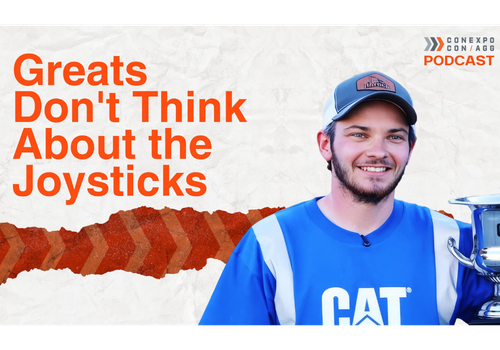



Brian Hayden runs heavy equipment in Wells, Maine, where he works for Hayden Excavating with his father. While most local operators never test their skills on a world stage, Brian entered the 2026 Caterpillar Global Operator Challenge to see if he was truly good. In the end, he beat all other finalists from the Americas, Europe, and Asia at CONEXPO in Las Vegas.
He explains the way he won the loader and dozer grading challenges, and shares how 3D grading and Leica systems save time on residential home digs. Listen in and learn how a small family business produced the best operator in the world.
Topics:
- CAT Global Operator Challenge
- Pro vs amateur operators
- Excavator skills and dozer grading techniques
- 3D machine control setup and GPS site layout benefits
Watch now:
Listen now:
Listen on your favorite app: Apple Podcasts | Spotify | YouTube
Subscribe to the CONEXPO-CON/AGG YouTube channel to be notified of new episodes.
Join more than 65,000 industry peers who receive construction industry news and trends each week. Subscribe to CONEXPO-CON/AGG 365.
Episode transcript:
Taylor White: Welcome back, everybody, to the CONEXPO-CON/AGG Podcast. I am your host, as always, Taylor White. Brian Hayden is with us here today. He is out of Wells, Maine, and he just won the 2026 Caterpillar Global Operator Challenge. That is not the regional title. That is not the national title. That is the world title. There were nine finalists from across the Americas, Europe, and Asia. Using three machines, a 938 loader, a 320 excavator, and a Centennial Edition D4 dozer, Brian came out on top and won two of the three challenges outright. Brian, welcome to the show. I am happy to have you here.
Brian Hayden: Thanks for having me.
Taylor White: Walk us through the moment that you realized that you had won. What was going through your mind? This is something that has been going on for years, right?
Brian Hayden: Yes. This is Caterpillar’s third go-around in the Global Operator Challenge. It started in June 2025 at the local dealer level. That led us all the way to Vegas after a few competitions. It was a wild experience being up on that stage at the end of a very long day.
Taylor White: Brian, fill us in a little bit about the road to getting to Vegas and that day. It was not just that one day of events. Explain a little bit of the background of what the CAT Global Operator Challenge entailed.
Brian Hayden: At the beginning of last year, Caterpillar sent out an email. I just happened to catch it in the bottom of one of their flyers saying that it was coming back around for the third time. I decided to sign up for my local dealer level. I went down to Seekonk, Massachusetts, and competed against 16 or 20 of us, and I ended up taking first place down there.
From there, they told me I was going to the regional finals. They took everybody from the eastern side of the U.S., including Canada, and divided the eastern and the western. I was there on the first day and went against 15 other competitors in Clayton, North Carolina, at the Caterpillar facility. I took first place there. Two days later was everyone from the western side of the U.S. and Canada. They took the winners from both sides and sent us to Vegas for the global finals.
I got there three days before the challenge. Caterpillar ran us through everything, including the events we were going to be doing. Then, on Tuesday morning, the first day of the CONEXPO show, we headed out to the arena. That was competition day. It was hot. It was a long day, but it was a good day.
Taylor White: Did you go into it expecting to win, or was it just a matter of throwing your hat into the ring?
Brian Hayden: I did not expect to win any of the challenges, not even at my local dealer level. I saw this three years ago and wanted to compete, but I was not 21 yet. I was about a month off from being 21, so I could not. This time, I decided to throw my hat in the ring and see how I stacked up against other operators. Every time I progressed, I thought, "This is when I am going to get knocked out. There is no way I make it through here." And here we are.
Taylor White: You obviously must have known that you were a good operator compared to others. This is what you do day in and day out. You are not just seeing a shovel behind you.
Brian Hayden: I work for my family's business, Hayden Excavating, which my father started in 1999. I was born in 2001, so I have been in this stuff my entire life. I knew I was a good operator. It is just me and my dad. I am the operator, and he is the truck driver. I knew I was pretty good at a young age. We would be on job sites, and if my dad had employees or laborers, he would tell them to get out of the machine because I was running it. I like to think it was because I was actually better than them and not just because he was playing favorites.
Taylor White: There is nothing wrong with that. It is the same thing for me. I am the third generation. My grandfather started our business in 1968, then my dad took over, and I joined eight years ago. My dad is still very much a part of the business. There was a time when I was out in the machines every single day, and I almost miss it. I envy where you are right now with your dad. Tell us a little bit more about the family business.
Brian Hayden: Ever since I was born, any chance I got on weekends, after school, or on days off, I was with him. He always joked that I could not get up at 7:00 a.m. to go to school, but I could be up at 5:30 a.m. to go to work with him. For the most part, it is just the two of us. If we need a laborer, we will take someone on, but we usually stay as a two-man team. I am always in the machines, and he is in the truck doing all the back-end business stuff. I have the fun part of the job.
Taylor White: Is there interest in the future of you taking the family business over?
Brian Hayden: Yes, that has been my goal my entire life. Every school project I ever wrote was about taking over the family business. It is definitely in the near future, hopefully.
Taylor White: I was the same way. People always ask how I knew I wanted to do this as a kid. I would tell my teachers that I wanted to run machinery and own a construction business. I never wanted to be a firefighter or a cop. What type of work do you guys specialize in?
Brian Hayden: It is mainly residential, though we take on some smaller commercial stuff. We do it all. We will come in and clear the lot, dig for the foundation, and handle the septic system, water line, and power. We do everything from start to finish.
Taylor White: What kind of machine is that behind you? Is that a 316?
Brian Hayden: Yes, it is a 316.
Taylor White: I like the counterweighted 316. It is a nice machine. What else do you guys have?
Brian Hayden: Every time I start listing stuff, people think we are nuts. It is a lot of equipment for just two guys. We have two tri-axles and a ten-wheeler. We have three skid steers, three excavators, a loader, and a backhoe.
Taylor White: That is just for you and your dad? Do you ramp up in the summertime and hire a laborer?
Brian Hayden: A couple of summers ago, we brought someone on. Last year we had a big trucking job, so we did not need anyone. This year, we might, because we have a lot of work lined up.
Taylor White: What size excavators do you have? Is the 316 the biggest?
Brian Hayden: The 316 is our biggest for now. I also have a Next Gen 313 and a 304 mini.
Taylor White: The 304 is great. We bought a 305 last year. CAT puts a lot of thought into the smaller machinery now. Have you always used CAT equipment?
Brian Hayden: Yes. Our backhoe is a Case, which is how my dad started. He started with an old 580 Case. We have upgraded since, but we still have an older 580 Super M Series 2. It pretty much just stays in a gravel pit to load the truck or move things around.
Taylor White: What separates a good operator from a great one in your opinion?
Brian Hayden: Anyone can jump in a machine and be a halfway decent operator. The guys who are in the equipment every single day perfect the craft until it becomes mindless. It is just second nature to them. Consistent guys who always turn out a good product or leave a job site looking good are the great ones. I also think a good operator takes care of their equipment. If they keep the counterweights clean and the cab tidy, it shows they care, and their work reflects that.
Taylor White: I agree. There is a difference between running and operating a machine. Anyone can run it, but not everyone can operate it. I love seeing an operator take the time to shape a berm so the water runs off nicely. Presentation matters when people drive by our job sites.
Let's talk about the challenges in Vegas. There were three: Ace of Loaders (938 loader), Street Gambler (320 excavator), and Centennial Push (D4 dozer). In the Ace of Loaders, you were knocking dice off cones with forks while running an obstacle course. How did you approach the tool transitions?
Brian Hayden: The first thing you had to do was put between eight and a half and nine and a half tons on a haul truck using the onboard scales. I listened to people after they went. A lot of guys went way over or way under. I was able to figure out how much the bucket weighed. When I came through the cone course, I was just winging it. I would fly by the seat of my pants and do whatever felt right at the time.
Taylor White: You also won the Street Gambler with the 320 excavator. You were threading a corrugated tube into a larger one, placing a manhole cover, and doing a max payload in three passes. What was the trick to that finesse work?
Brian Hayden: I was shocked when they called my name for that one. When you are in the machine, it feels like you are there forever. I was the first one to go, so I could not watch anyone else. The pipe was tricky. In the regional level in North Carolina, we were sitting on a berm, so the teeth were pointed uphill and the pipe would not fall off. In Vegas, we were sitting below it, so the excavator had to be at max height. I almost dropped the pipe at the end, but I got it in just as I was losing it.
Brian Hayden: For the payload, they told us to put three buckets on the haul truck. I decided to swing as fast as I could and dig in the loose stuff. I got the third most amount of weight, but the time savings made more sense for the total points.
Taylor White: The last one was the Centennial Push with the D4 dozer. You won this one as well. It involved a tire push through obstacles and fine grading. Walk us through that.
Brian Hayden: That was the last one of the day. Going into it, I was in third place and had to make up about 60 points. I decided to just hammer down. People do not believe me when I tell them this, but we do not own a dozer. I love running them, but I only have maybe 100 or 150 hours total in the seat.
Taylor White: What were the biggest differences between competing against people from Europe, Asia, and the Americas?
Brian Hayden: I saw differences at every stage. In the local level, we all run the same stuff. At the regionals, I met guys from the Midwest who only use track loaders and barely touch excavators. The brand new 938 had stick steer, and not many people had run that.
Taylor White: You won the Global Operator Challenge. Does that change anything for you?
Brian Hayden: I have had some companies reach out wanting to send me products or clothing. I have done a lot of interviews for local news and newspapers. For the first few weeks, at least one person would stop me in public to congratulate me. We have received about half a dozen calls for work because people saw me on the news. One guy wanted a septic system done and said, "I want the best operator in the world to do it."
Taylor White: What advice do you have for other young people wanting to be operators?
Brian Hayden: You have to do the grunt work and the groundwork first. You need to see things from the ground so you know how to make it easier for the laborers when you are in the machine. You just have to work your way through the ranks. Any chance you get to get in a machine, take it. There is no way to learn this by reading. You physically need to be in the seat.
Taylor White: You mentioned you use Leica 3D. Tell me about your experience with that technology.
Brian Hayden: We are pretty minimal with our tech, but I have Leica 3D on the 316. We bought it from a local company because they answer the phone whenever I have a question. My dad is old school and wanted to pull tapes and use a laser. We had a subdivision road with a 400-foot detention pond, and I convinced him the job would pay for the system. I built that whole pond and the road without getting out of the machine. After that, he finally admitted I was right.
Taylor White: Technology is a game changer for layout. If you could design one feature into the Next Gen excavator, what would it be?
Brian Hayden: CAT has it pretty dialed in. I would love for 3D grading to come right from the factory instead of just 2D. I would also make the 2D even more user-friendly for operators who are not tech-savvy.
Taylor White: Are you defending the title at the next challenge?
Brian Hayden: I would love to, but once you win, you cannot compete again. I mentioned to CAT that they should bring the past winners back for a battle of the best once they have more champions.
Taylor White: That is a great idea. I appreciate you taking the time to talk with us today, Brian. Congratulations again.
Brian Hayden: Thanks for having me on. I will definitely be at the next CONEXPO.