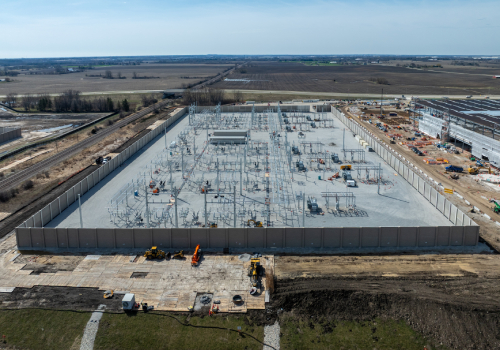
Driving past a new data center site, it’s easy to assume the work is already assigned to national builders who bring their own trade partners. The money tells a different story.
Engineering News-Record’s 2026 Top 400 Contractors report shows revenue climbed 11.8% to $671.4 billion in 2025, and it credits much of that to data center work and the power and infrastructure buildout trailing it. Anirban Basu, chief economist at Associated Builders and Contractors (ABC), describes data centers as the one segment still pushing nonresidential construction spending higher.
Chuck Goodrich, chief executive of Indianapolis-based Gaylor Electric, says data center work now makes up 50% to 60% of his business, with revenue on track to reach $1 billion this year. “From a biblical perspective, we happen to be living the life of abundance,” Chuck says.
Electrical, mechanical and plumbing scopes capture the biggest share of a data center budget. However, the same demand is reaching the site and civil trades that prepare the ground long before any gear arrives.

Avoid positioning the company as a full-project provider. Focus on the scope of work where it has the strongest expertise and deepest experience.
HOW TO FIND OPPORTUNITIES
Follow the dollars and the opportunity gets concrete. A data center pours an outsized share of its budget into electrical, HVAC and plumbing systems, well beyond what a typical office building spends on the same work. Structure itself is a comparatively modest piece of the total.
These projects demand heavy early work: mass grading for level, vibration-controlled building pads, stormwater detention, erosion and sediment control, deep utility trenching and access roads built for heavy equipment and fuel-truck traffic. A single campus can run from under 100 acres to more than 1,000.
Site prep, underground utilities, paving, concrete, trucking and erosion control are all essential to data center construction. In fact, ABC reports that about one in seven of its members already holds a data center contract.
WHAT GENERAL CONTRACTORS CONSIDER
General contractors decide who gets the package long before the dig starts, and they prequalify trade partners hard. Hyperscale owners often layer on design and quality standards that go beyond local code.
The checklist comes down to a few things: a clean safety record and real OSHA compliance, documentation tight enough to prove quality on demand, bonding capacity that fits the scope and, most of all, schedule certainty. Data center timelines are unforgiving, and a sub who slips a milestone gets noticed fast.
Understanding the common friction points is equally important. Long lead times for critical electrical equipment, power constraints and labor shortages can all affect project schedules. While these issues may fall outside a contractor’s scope, recognizing them demonstrates an understanding of how data center projects are sequenced.
HOW TO GET IN
Avoid positioning the company as a full-project provider. Focus on the scope of work where it has the strongest expertise and deepest experience.
From there, the moves are straightforward: get prequalified with the major GCs active in the region, target the early packages where a regional firm can build a track record, like site prep, utilities and the perimeter, then start talking to GC preconstruction teams during planning.
Geography narrows the target. Texas, Virginia, Arizona, Georgia, Illinois and Ohio lead the pipeline of announced and under-construction projects, with emerging activity in states like Mississippi, Minnesota and Missouri.
Growth has eased off its recent peak, but spending keeps climbing in real terms and the pipeline runs for years. This is a decade-long buildout; there is still plenty of time to get in the door.
The contractors must be clear from the start about the one thing they do well and deliberate about building the relationships that turn a first package into a second. Find that fit before chasing the work.
Learn more about the top 5 Emerging Markets for Construction in the U.S.: Opportunities for Growth to explore more opportunities.
PHOTO CREDIT: SHUTTERSTOCK.COM/CFLATEN