Robotic printers are starting to pour walls on active job sites across the country. Interest in 3D printing keeps growing as material costs and labor shortages squeeze margins on commercial and infrastructure builds. New printers and mix designs are changing what crews can build and how fast they build it, which puts pressure on contractors to understand where the technology actually fits before a client asks about it.
Automation on the jobsite used to mean bigger machines doing familiar tasks a little faster. Printed concrete changes the equation by building entire wall systems layer by layer on site. That shift changes what crews do during a pour and what they need to know before mobilization.
How 3D Printing Works on the Jobsite
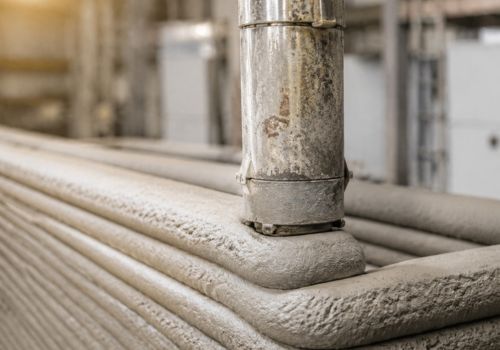
A gantry, which is a large robotic arm moves the printer nozzle along set paths and drives up walls one layer at a time. Layer by layer, the printer extrudes a specialized concrete mix that holds its shape immediately, which means no forms, studs or masonry crews are needed to shape the walls before the concrete sets.
The pace on real projects has caught attention across the industry. Alquist 3D completed a 5,000-square-foot commercial expansion at a Walmart Supercenter in Owens Cross Roads, Alabama in just seven operational days, with a five-person crew running two printers and working through weather conditions that would have halted traditional concrete masonry unit (CMU) block construction. The team completed the print roughly 50 percent faster and 15 percent cheaper than a conventional approach on the same scope.

Adopting a printer for 3D printing commercial or residential structures means more than buying new equipment and calling it done. Crews need training on mix design, calibration and daily printer maintenance before the first pour.
Adopting a printer for 3D printing commercial or residential structures means more than buying new equipment and calling it done. Crews need training on mix design, calibration and daily printer maintenance before the first pour. Cost per square foot still favors traditional framing on most standard projects, which is why speed advantages usually show up first on repetitive designs and simple wall geometry across a full site plan.
Concrete Pump Technology Still Matters
Every printer depends on a steady, well-mixed supply of concrete reaching the nozzle without a clog or delay. Concrete pump technology built for traditional pours now feeds many of these robotic systems, and getting the flow rate right matters just as much as the printer's own programming.
Printer downtime hits harder on a 3D print job than on a normal jobsite because the whole crew waits on it. A clog can end a print day, and once a layer cures unevenly the next layer will not bond correctly, which forces the crew to demo and restart the affected section.
Watching pressure and flow data closely helps crews catch a clog before it stalls an entire pour, which is why the research on shape fidelity and process variation in 3D concrete printing keeps focusing on real-time monitoring as the path to reliability.
Newer printers pair a robotic arm with a boom similar to a concrete pump, which lets crews print multistory walls without repositioning heavy equipment between passes. That kind of vertical reach matters because repositioning a printer mid-pour is one of the fastest ways to introduce the layer misalignment that shows up later as a structural flaw.
How Building Codes Are Catching Up
Even with faster printers and better pump systems, code adoption still shapes how quickly the technology moves into mainstream commercial work. Code officials increasingly treat printed walls the same way they treat standard poured concrete under current building code requirements.
The International Code Council has been developing ICC 1150 since October 2023, the first dedicated standard for 3D Automated Construction Technology for concrete walls, with public comment periods running through 2024 and 2025
The standard covers interior and exterior 3D concrete walls with or without structural steel reinforcing, used as bearing walls, non-load-bearing walls and shear walls in single-story or multi-story structures. Formal adoption gives contractors and inspectors a common reference point for the first time, which matters when a printed structure project needs financing, insurance and permit approval.
Without that reference, individual jurisdictions have been approving printed walls case by case, which adds weeks to the front end of every project and forces contractors to re-litigate the technology on each new bid.
3D Printing Is Ready for the Right Jobs
Printed concrete will not replace every wall on every jobsite anytime soon. It is already reshaping how contractors think about speed, labor and repetitive wall designs, particularly on projects where the same geometry repeats across dozens of units.
Contractors positioned to capture the value first are the ones learning the technology now, before a specific bid forces the decision. Building crew skills on emerging construction materials and methods early gives contractors time to work out code familiarity long before the first paying client asks for a printed structure.