Sustainability is often seen as a constraint in construction; another requirement layered onto already complex projects.
But what if it could help solve some of the industry’s toughest challenges?
That’s the perspective shared by Autodesk Chief Sustainability Officer Joe Speicher and Autodesk Vice President of Product Management and Engineering Lalith Subramanian.
They say it is time to stop seeing sustainability as a burden and start seeing it as the industry’s biggest opportunity.

“Sustainability at its core is a data problem. When your teams don't have trusted data, we get waste, we get rework, we get delays.
Joe Speicher
Autodesk
SUSTAINABILITY IN CONSTRUCTION
The construction industry accounts for roughly 32% of total energy globally and 34% of carbon emissions. The industry must find ways to evolve and reduce its impact.
“Construction isn't just part of the climate conversation. It is the switchboard,” Joe stresses.
Construction leaders are realizing that integrating sustainability into existing processes improves performance and saves money.
In fact, many companies are already addressing sustainability, whether they realize it or not.
In construction, this includes:
-
Carbon management: Understanding the cost and risk embedded in material and procurement decisions.
-
Energy efficiency: Designing assets that cost less to operate.
-
Water efficiency: Building resilience in a world facing growing water scarcity.
-
Resilience: Creating assets that can withstand disruptions such as extreme weather, supply chain issues or operational failures.
TRANSFORMING PROJECT DELIVERY
Traditionally, sustainability has been treated as a downstream compliance task, but that’s not the whole story.
“What happens upstream in design, planning and procurement determines what’s even possible downstream,” Joe explains, adding that disconnection across project phases creates waste and rework
That’s why sustainability is beginning to shift earlier in the project lifecycle.
“We’re seeing sustainability evolve from a response to regulation to a lever for transforming how projects are delivered,” Joe says. “Leaders are realizing that integrating sustainability into existing processes improves performance.”
The greatest opportunities occur before the first pour.
Key areas to consider include:
-
Preconstruction and design: Evaluate materials, energy performance and procurement strategies.
-
Integrated modeling: Analyze cost, schedule and carbon together.
-
Early coordination: Connect teams across design, procurement and construction.
To put it simply, what is good for the environment is good for business. A dumpster of waste that is recycled instead of sent to the landfill is a dumpster of waste you don’t have to pay to dispose. Planning creates a roadmap for more sustainable projects
TECHNOLOGY AS AN ENABLER
Technology is where sustainability stops being aspirational and starts becoming scalable. This is where companies can use digital tools to help make sustainability actionable.
Examples include:
-
Connected workflows: Link design, construction and operations for seamless data flow.
-
Digital takeoff: Evaluate costs, lead times and carbon intensity together.
-
Field tracking tools: Monitor waste and rework in real time to optimize procurement.
“Sustainability at its core is a data problem. When your teams don't have trusted data, we get waste, we get rework, we get delays,” Joe shares.
When sustainability metrics are embedded in dashboards, alongside cost and schedule, it is no longer a side initiative or something to tackle later. The data is integrated with other project metrics to give you a full picture.
STEPS TO GET STARTED
As the industry faces pressure to build faster, stay competitive and cut the carbon emissions, the time to start your sustainability journey is now. Companies that want data to drive results should not try to change everything all at once.
“The companies that are gaining advantage in this area are not waiting for perfect data; they're starting off in small ways,” Lalith advises.
Here are a few ways to get started today:
-
Implement digital takeoff with carbon analysis.
-
Connect workflows in preconstruction and estimation.
-
Track materials, waste and carbon in the field.
-
Feed data back into design and procurement decisions.
These small changes add up across projects, companies and the industry.
“Sustainability stops being a constraint and becomes a competitive advantage,” Joe says.
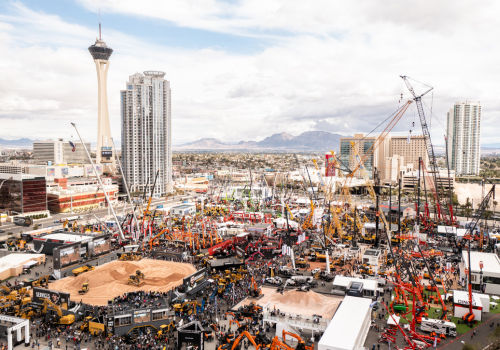
Dive deeper into this topic with the session From Constraint to Competitive Advantage: Reframing Sustainability in Construction, led by Autodesk at CONEXPO-CON/AGG 2026, in our free on-demand recordings of the Ground Breakers stage.
PHOTO CREDIT: SHUTTERSTOCK/ZUYEU ULADZIMIR