Contractors have been here before. Fuel prices spike, margins tighten and everyone scrambles.
But what’s different right now isn’t just the cost; it’s the uncertainty.
Diesel prices have climbed sharply in recent weeks, driven by global supply disruptions and geopolitical pressure. At the same time, construction costs are rising faster than inflation, with fuel playing a central role.
Running equipment to move material is essential. Running equipment soley for operator training is becoming harder to justify, especially when alternatives exist.
That’s why virtual reality (VR) simulator-based training is emerging as a direct response to rising operational costs.

The goal isn’t just to use less fuel; it’s to stop wasting it in the first place.
WHY VR TRAINING IS GETTING A SECOND LOOK
Virtual reality training has been around for years, typically positioned as a safety or workforce development tool. Those benefits remain, but the value proposition is shifting.
Today, it’s increasingly about cost.
Simulation allows operators to train without using real machines, which eliminates fuel use, reduces wear and keeps equipment in production.
Instead of learning entirely on live equipment, operators can build core skills in a virtual environment and arrive on the jobsite more prepared, all while reducing the total hours spent training on fuel-burning machines.
Simulation also changes how operators learn. Instead of avoiding mistakes, they experience them without costly consequences. This allows operators to get better quicker because they can experiment with different scenarios that could occur in the field.
“We like to say at our company, failure is the goal,” shares Greg Meyers, CEO and Co-Founder of ForgeFX Simulations.
WHAT THIS LOOKS LIKE IN PRACTICE
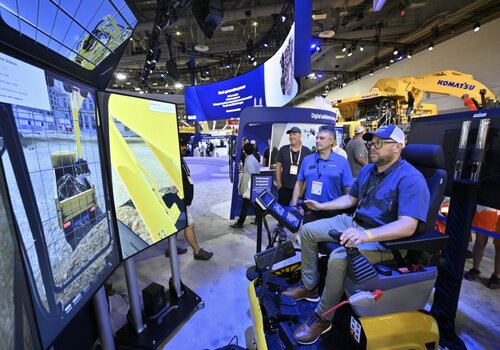
Across the industry, simulation is being positioned less as a niche technology and more as a scalable training solution. This shift was visible across this year’s CONEXPO-CON/AGG show floor.
HD Hyundai Construction Equipment provided a hands-on experience as part of its Shop Talks & Walks program. Attendees explored maintenance procedures “in a shared virtual reality environment” where two users trained together, learning machine systems and service steps before ever touching real equipment.
Companies like CM Labs have updated systems like the Intellia Workforce Training System designed to standardize and manage operator training across fleets and locations, while Caterpillar is expanding its Cat® Simulators.
The common thread is efficiency.
In a traditional model, operators may spend dozens of hours learning on live equipment. Every hour consumes fuel, adds wear and generates no production.
With a simulation-first approach, early learning happens virtually. By the time operators reach real equipment, they’re more efficient and require fewer total training hours.
That means fewer gallons burned before productivity begins.
And connected, multi-user simulation reduces expensive travel budgets because trainers and trainees do not need to gather in one physical location. Some customers have saved 30% to 50% in travel budget alone.
“I put on a headset here in Las Vegas, you put on a headset in New York,” Greg shares. “We’re able to connect and train as if we were in the same room.”
PREPARING FOR THE FUTURE
Fuel prices will rise. They’ll fall. And then they’ll rise again. That cycle isn’t new. But what contractors do about it is starting to change.
VR training is helping contractors cut fuel use before work even begins and protect margins in a volatile market.
“If we can remove that variable from our equation and let people just burn virtual fuel as much as they want, then you’ve really got an equation for success,” Greg explains.
Virtual fuel vs. real fuel is becoming a defining concept because every hour spent training in a simulator is an hour not spent burning diesel in the field.
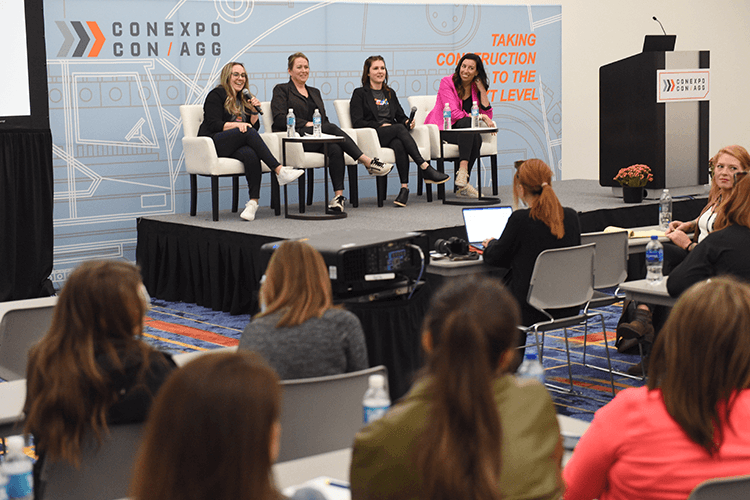
Dive deeper into the benefits of VR simulation from Greg Meyers in the free, on-demand session From Iron to Impact: How VR Simulation is Transforming Heavy Equipment Training.
PHOTO COURTESY CONEXPO-CON/AGG