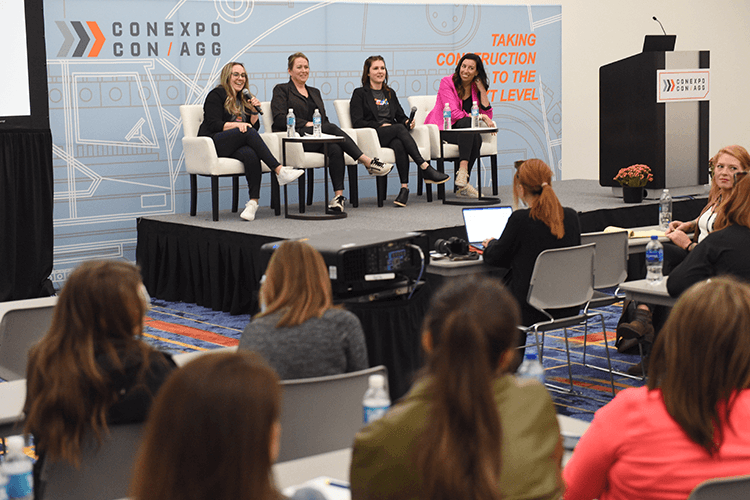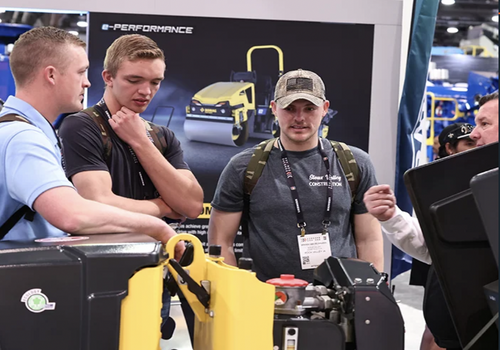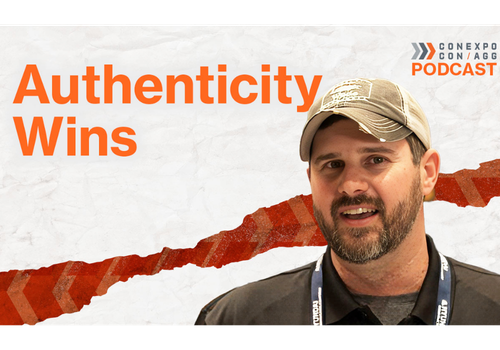



Mike Simon - better known as Dirt Perfect - is back on the podcast today! Since his first appearance, Mike has grown his YouTube channel to over 500,000 subscribers, all while running his excavating business. In this live recording from the CONEXPO-CON/AGG 2026 Community Zone, Mike sits down with Taylor to talk about what's changed, what hasn't, and why his "hobby" now earns more than his business.
From the emotional reason he started filming to the practical realities of balancing brand deals with job site work, Mike delivers a first-class lesson in authenticity. He and Taylor dive into why the trades are still undervalued, how social media is a powerful free advertising tool, and why knowing your "why" matters more than chasing views.
Topics:
- The "why" behind the camera
- Why the trades are a smarter career than you think
- The secret to half a million followers
- Advice for starting out in business and on social media
Watch now:
Listen now:
Listen on your favorite app: Apple Podcasts | Spotify | YouTube
Subscribe to the CONEXPO-CON/AGG YouTube channel to be notified of new episodes.
Join more than 65,000 industry peers who receive construction industry news and trends each week. Subscribe to CONEXPO-CON/AGG 365.
Episode transcript:
Taylor White: All right, welcome, everybody. Thanks for coming out to the Community Zone. It means a lot. You guys are probably here to see Mike over me, so that is good. Me and Mike were on a panel this morning, so we got kind of warmed up. But I want to thank you guys all for coming out for the CONEXPO-CON/AGG Podcast. As Melissa mentioned, I am your host, Taylor White, and I get to do this bi-weekly for the past three or four years now, and it has been a blast.
So I guess a lot of you guys probably know who Mike is, but, Mike, if somebody said to summarize what you do and make it sound badass, because what you do is badass, let’s hear it.
Mike Simon: That is a loaded question. How much time you got, Taylor? So, I live in southern Indiana. Been in the excavating business for almost 20 years now, which honestly makes me feel a bit old. Had a few different versions of it, but about 10 years ago, kind of really scaled back the business. Had this crazy idea to start a YouTube channel, not to really get rich or famous or any of those things. I just thought it would be a cool hobby and a cool way to kind of document my life. And for some crazy reason, the YouTube world grabbed it, took off, and we have been kind of running ever since. And so all the locals know me as Simon's Concrete and Excavating, and everybody else in the world knows me as Dirt Perfect.
Taylor White: And, you know, he is kind of being humble because you have like half a million people that follow you on YouTube. That is a lot of people. That is like 25 of my hometowns that I grew up in, so that is amazing.
Mike Simon: Yeah, every time my daughter makes fun of me, she says, "Dad, that video only got 67,000 views." I am like, "Do you realize that is how many people were also at the Super Bowl?"
Taylor White: What made you start doing this? I have it written down here that you started as a way to document your work and your life, but what made you start where you are and what did it evolve into?
Mike Simon: So, the first 10 to 15 years of the business, we actually had three different businesses: excavating, we were building high-end homes, and also had a real estate development business. And I am a guy that likes to be in the dirt. I like to be hands-on. I was managing a lot of stuff, the kids were getting older, and I did not have time to spend with them that I wanted to. I kind of made the decision in 2017. I said, "You know what? Enough is enough." We shut down the construction business, sold off all the real estate, and I just went back to digging in the dirt. I thought, "I am going to do what makes me happy. If the money comes, the money comes. If the money doesn't come, I guess we are sleeping on the porch."
I think this can be applied to a lot of things. So many people chase salaries and they chase titles, and they end up down the wrong path. And I just finally decided I was going to do what I was passionate about, and that was digging in the dirt. And I gotta be a busy person. I had a little bit of free time, or thought I did. I also had a neighbor that was doing pretty successful on YouTube at the time, Logger Wade. And he was kind of pushing me. He said, "You will be good at this. Give it a try." And I justified it.
The main reason I did do it was to document my life. Not to go down a rabbit hole here, but unfortunately, I lost my father in an accident 20-something years ago. He was a heavy equipment operator, and we got a lot of still pictures and some photos of some cool projects he did, but no video, no documentation of anything. I thought, "You know what, 30 or 40 years from now, whenever I am here or not here or whatever happens, we have always got this library of stuff to go back and look at." And I have only been doing it seven years, and it is still really cool to go back, see the equipment you had seven years ago, relive the projects you did seven years ago, and see the kids grow up in the videos that they are in. See how much gray hair I got now over the last seven years. But it is obviously evolved from that, but I still try to make it focused around that.
Taylor White: Yeah, sorry to hear about your father as well. Nobody wants to hear that, but you said something this morning that I thought was pretty interesting. Someone actually mentioned to me after we were on a panel this morning, you said YouTube is what you do, and you do the contracting just for content.
Mike Simon: So, that is true. How do we want to word this here? The main business I still focus on is excavating. If I am on a job site, the customer is still the priority. The excavating business does still make money and pay bills. The crazy part is the social media world makes more money than the excavating business. So how do you balance that out?
I see a lot of YouTubers, and I think you might be or might know what I am talking about here, but you see these guys that start having success on YouTube, they quit their job and they go full-time into it. The channel changes, the dynamics change, and all of a sudden the YouTube starts cranking down. And I still enjoy YouTube. I did not want it to be a job. So I kind of limited myself on how much time I put into it, how much effort I put into it, and I really try to keep it fun and I really try to keep it hobby-focused. And it just continues to grow. It seems to work, and it is what works for me.
Taylor White: What is your favorite thing that you get to film? Because I think my favorite thing that I have seen of you is you bought an old D8, right? Or D6?
Mike Simon: Yeah, D6.
Taylor White: And it was like trying to get it running in the middle of the bush or whatever. That was pretty cool. What is your favorite thing to kind of film?
Mike Simon: Honestly, if you guys follow the channel, you know we do all kinds of stuff from pipe install to ponds and site work. But my favorite thing to film is probably the engineering projects we do in the shop. A lot of the fab work and stuff. I just think it is cool to take a sheet of metal or take an old broken-down tile plow and basically rebuild it with what we got available to us. And those videos seem to do really well. It is probably because it is kind of my passion as well. The dirt projects, they are fun to film, but you can only film a dump truck dumping dirt so many times. You know what I mean? You got to kind of speed that stuff up to keep it going. And then as the kids get older and they get more involved in the business, it is obviously fun to have those guys involved with what we got going on.
Taylor White: You mentioned this morning about your content being content, but people follow the person. So I want to ask you, why do you think that people follow you? What do you think makes you interesting?
Mike Simon: That is a great question. I don't know. I think it is just being authentic. Not trying to pretend to be something you are not, trying not to act like somebody you are not. We all got an ego. We all want to be the big dog on the stage, right? And sometimes that person is hard to relate to. So just be who you are. We film in the platform of just come to work and hang out with us. We are not trying to teach you anything. We are not trying to cram anything down your throat. We may be showcasing a new piece of equipment, but it is just a life on the job site. What is life like on the job site? Sometimes it is really good and you have some wins, and some days you drop a tree on the excavator and it costs you 20 grand.
Taylor White: You started working with a bunch of brands as well. And you showcase the machinery on site. Was that kind of cool, I guess, to start building that? What was your first thing when you started posting YouTube videos and you got that email or something that sounds like, "Oh, wow, they want to work with me and showcase their product"? That is really cool.
Mike Simon: So, I got kind of a crazy story of how I got started with the brand thing. I had like 7,000 subscribers. I had been doing YouTube for maybe six months and went to another show put on by AEM called the Utility Expo, pretty close to our hometown. And Hyundai had a booth there and they had this game called "Excavator Soccer." And they had this guy out in the aisle way. He was a loudmouth on a microphone, and he was just begging for people to come in there to play. So I walked up to him with the camera and I asked, "So what is this deal?" And he was trying to explain it. I said, "I have never heard of an excavator, but I played soccer before. Let’s give it a try."
He kind of gave me a funny look. I walked in there, asked him what the fast time was, and he told me. I said, "Well, if I beat it by three seconds, can I get a free excavator?" He said, "Sure." He had no idea who I was. It was a little bit of luck involved, but I did beat it by four seconds and went after my free excavator. And that actually turned into my first demo. I did not actually get to keep the excavator, but that is how I got started with Hyundai. Very thankful for them. They kind of took a chance on me whenever I was a nobody. And then seeing the work I did with Hyundai is what kind of opened the doors to the other manufacturers.
Taylor White: What are your favorite brands that you kind of get to work with nowadays? Or what are you looking for in the future?
Mike Simon: I have been so lucky to do so much. And you have worked with multiple different brands. You know how each one of them operates so differently, and there are good things and bad things about any of them. A lot of it has to do with me, and I think this also goes if you are buying equipment: is the relationships. Because they all make good equipment, they all make bad equipment, but your relationship with the brand or the dealer is more important than anything.
But what is important to me is it has got to be easy. Like the first brand deal, you are all in, you are going to make this great, you are going to put all this effort into it, and you realize that is a lot of work. And I don't know if I got time to manage that. So building up these relationships with these different brands and just getting their trust and different things.
Probably the funnest part is my relationship with Case is actually with the engineering department. So providing a lot of feedback. The new N-Series dozer that is here at the show now, there are a lot of things on that dozer that we had a lot of influence on, like the speed control and layout of the cab and some visibility things. So it is kind of cool to see that over three years go from the drawing board to sitting on the showroom floor here.
Taylor White: Yeah, I think what is really cool too is being able to get opportunities like hosting the CONEXPO Podcast or being at CONEXPO and sitting on panels and talking. It is pretty surreal. What do you think being at the show this week and how does it feel? Because you are a part of a lot of stuff this week.
Mike Simon: It is definitely a different experience than coming here just as an attendee. But it is cool to be able to give back because I know there are a lot of people out there kind of curious about what we do. And more importantly, we need people in this industry and this is a really cool industry. So anything we can do to promote the trades, promote the industry, let people know there are good jobs here. That could be supporting a manufacturer, that could be supporting the show. That could be done in a lot of different ways.
But these events are phenomenal. I mean, this is the largest trade show in North America. Absolutely incredible what is here. It doesn't matter if you are looking for technology, workforce stuff, the newest, the latest and greatest, it is here somewhere. There is something for everybody here, I promise you that. It is just: how fast can you find it?
Taylor White: Yeah, and you touched on a good point. A lot of people talk about right now how it is really hard to find people. And you talk about AI coming in and all that stuff. I would love to know, what do you think that our industry does wrong to not promote it? And I want to talk my opinion first. I think it starts with the school, with education. I mean, I remember basically if you don't do the university academic classes, you do applied, well, you are just going to be a "dumb tradesman." And that is not the case. I know a lot of tradesmen that make a lot more than people who went to college, and I hire people that went to college and university. I think that it is just looked down upon and I think we kind of need to change that. So that is my opinion.
Mike Simon: You are absolutely spot on there, Taylor. You know, I think it is a little bit of a generational thing. I graduated high school in 2000. And at that time it was made very, very clear to me if I wasn't going to further my education and go into the trades, I was doing that simply because I wasn't smart enough to do anything else. And I was one of the random, rare kids that I knew from about age five that I knew exactly what I was going to do. I was going to be self-employed, I was going to have my own business. I didn't know how I was going to be modeled, shaped or what I was going to do, but that is what I was going to do. And nobody was going to tell me any different.
I had a very candid conversation with the principal at the school at the time whenever I was walking out the door. I said, "Listen, if you keep pushing this the way you are pushing it, you are still gonna need somebody to build your bridge, build your house, fix your toilet, put tires on your car. And 20 years from now that guy is gonna be able to name his price."
And that is exactly what has come around. And everybody is a little bit in a panic mode. And to your point, the reality of it is one of the kids I graduated with is now the assistant principal at the high school. He followed that program and did all that. I was speaking at a career day the other day, and the reality of it is my salary is six times what his is. There is good money here. There are jobs that you should not be ashamed of. I don't care if you are the trash guy. If that is what you are passionate about, be the damn trash guy and be the best trash guy you can be and go around and celebrate it.
We get so stuck on titles, we get so stuck up on salaries that we lose our passion, our happiness. And the money will take care of itself, I promise you. But I think a lot of the schools are finally seeing the value in the trades and the jobs that are here. And so many jobs you can go straight out of school straight into, or get paid to get trained versus the other way around. I do believe we are turning the corner, but we got a lot of work to do yet.
Taylor White: You know, I always say people aren't scared of hard work. You can make good money in the trades. I just think that it is a shame. It is almost like back in the '60s and '70s when they wanted people to start going to university. It is like a big marketing ploy, right? Where it is like, "Hey, you got to go to university, get education." Do you have any education? Any post-secondary?
Mike Simon: So I was forced to go to two years of post-secondary school. I got a degree. It is a joke. Applied Science, Diesel Mechanic. I don't even know what it is. I am just being honest. And I also want to be clear: if your passion is to go to university or to a two-year school, by all means, that is what you need to do. But if it is not your passion, don't go spend a whole bunch of money figuring it out.
But the best education I ever got is after I graduated, I went to work at a Mack Truck dealership. And through the events of September 11th, in two weeks I went from being the night shift oil change mechanic to the second guy in charge of 70 guys in the shop. And I was very fortunate to get sent to a lot of the Mack trainings. I was very fortunate to have some good mentors there. And in that two years working at that dealership, it has taught me a lot of lessons that I still carry on today with what I do.
Taylor White: What do you think, you know, people are in the audience right now or they are watching it after and they are young and they want to get into the industry. I feel like the barrier to entry is kind of easy. You just have to work very hard. What path would you try to put somebody on that wants to either run their own business in the industry or just go work for somebody else and put their head down and make a good paycheck?
Mike Simon: I think the first thing you need to figure out is which trade you want to be in. And if you can do that experimenting or helping out other people instead of doing it on your own and investing in that, I think you are going to be best. But whether you go the trades route through one of the halls, which they have some awesome programs, or if you don't go that route, if you are willing to work and show up every day on time, somebody is going to give you a chance. There is a good chance somebody there will be a great mentor. Don't be afraid to ask questions. Don't be afraid to interject yourself places you may not be comfortable. Ask why. Ask how. If you see a guy do something you can't do, whether it is with a piece of machinery or something like that, ask him what his technique is. Just treat the job site like a classroom and you will get something out of it. It is there; you just got to take it.
Taylor White: Yeah, and there is a lot of knowledge too. Like I know here at the show there are a bunch of education sessions and stuff like that too. And there are people that are doing it and have done it. And I think like you said, reaching out and gathering a bunch of information for people is really important for that too.
Mike Simon: Yeah. So before I ever started my business, I worked at a tire shop, I was a mechanic at a bowling alley of all things. I worked in home decor at Lowe's. I know, don't judge. Worked in the paint department and then I ended up being receiving manager at Lowe's and then went to the dealership and then eventually went out on my own. I did work at another construction company in between. But all those experiences have taught me something about what I wanted to do and how I wanted to be successful at it.
Taylor White: If you had one topic or one thing to tell somebody that was starting, what would you tell them?
Mike Simon: My big thing is, if you are going to start in business, don't get in over your head from the get-go. Some of our guys go out and buy all the new trucks and all the new equipment and they got to have the latest and greatest of everything, and then they are chasing a payment instead of chasing profit. And you don't know, as much research as you will do, let's just say buying an excavator for an example, until you actually put it on the job and start working, you don't know for sure if that is what you need. And so I just tell people to dip their toes in and give it a year or two. Go buy a nice used machine, there is good stuff out there. And then whenever you are ready to spend the big bucks, you will know exactly what you need, you know exactly how long it takes you to pay it off, and then you can grow and scale from there. But if you start off behind the eight ball, it is so hard to get caught up.
Taylor White: And what about doing long-form content to grow your business? And not so much maybe do like a personal brand, but what do you think somebody should do as far as going on social media and starting that?
Mike Simon: So I encourage anybody that is interested in social media to give it a try. I fully understand it is not for everybody. And I think the long-form content has kind of become the new version of reality TV because we are legit reality TV and we are a lot more accessible than what some of those guys are. But some guys like the short-term content too. But you know, even if your stuff doesn't blow up and you don't get the brand deals and you don't get all this stuff, there are still a lot of benefits. There are jobs we go back on for a second or third time, we are like, "Where'd we put that at? Where is the tank at?" We will just go back and watch the video. You know, another example is you got a customer that wants a septic system in and you call it a Presby septic. What is that? Shoot them a video over. You can use it to educate your customers as much as anybody. And the long-form content is a great advertising tool, even if it is just pinpointed towards one person.
Taylor White: What would you tell them about starting out and doing short-form content and going on Instagram and showcasing a job or showing photos and starting to do that sort of stuff?
Mike Simon: Yeah. So exposure is king. Right? So any way you can get exposure is great. And the one thing about some of these platforms, it is hard to control who sees it. So if you are trying to get business in your local market, you need to maybe choose the platform that is appropriate for that. Usually, Facebook is best for that. But anytime you can get stuff out there, them short-term or short-format videos, I use them as an educational tool too because we get in our own little world and we do stuff a certain way. Then you see some guy across the country doing it a different way and you are like, "Why didn't I think of that?" There are so many things you can pull out of that that are beneficial. But any exposure is usually good exposure. If you are a good, reputable business and you want to showcase your work, why would you not? And social media is a great way to do that.
Taylor White: Do you ever find it hard because you kind of branded and labeled yourself as Dirt Perfect and your business is a different business name? And I was talking this morning on a panel and I was about how I struggle with, because I did Ken White Construction, but now I have a different business, I have other businesses that I have been growing and buying. I want to showcase those. So it doesn't feel right to just show that on Ken White Construction. I am not on site every day like I used to be because the business has kind of outgrown me doing that and I struggle with that a lot. And so, I mean, we were talking about this morning. It is like personal versus business. Do you ever struggle with that or, you know, in your head, this is Dirt Perfect content, and that is what I am doing?
Mike Simon: Yeah, no, the lines have definitely got blurred a little bit. The actual name of my business is Simon's Concrete and Excavating. We call it Simon's C&E for short. And that is what all the locals pretty much know it as. I went off and branded it as Dirt Perfect because I thought this social media was basically going to be a completely separate business and I didn't know how much they were going to go back and forth. The reality, as time went on, the customers think it is cool to get an invoice from Dirt Perfect now instead of Simon's Concrete and Excavating. They have kind of morphed together into one.
But I think I was never doing social media to promote the business. It was more to just kind of as a fun thing. And that is why I wanted to keep it separate. There has not really been a struggle there. But I think your initial branding needs to have some thought into it for sure, like what your end goal is. If your end goal is to promote your business and what you are doing, then that needs to be strongly in the business. "Dirt Perfect," it is just kind of a generic name. It was supposed to be Dozer Dad and I wanted it to be Dirtball TV and the wife knocked that down, so it ended up being Dirt Perfect.
Taylor White: Yeah. How did you come up with Dirt Perfect? What is the reason there?
Mike Simon: If you want to know the honest truth, people see me in the comments, I am a bad speller. So it was Dozer Dad and then it was Dirtball TV and then I changed it to Dirt Perfect and I spelled it wrong and I changed it again. And YouTube will only let you change it three times in, is it three months? Well, by the time they allowed me to change it again, the channel already took off, so I was pretty much already locked in. But it is worked out great. You know, for what I do, the generic name works out good. I didn't know who Dude Perfect was at the time, and I get a little bit of flak for that every once in a while. But no, it is worked out good. It has been a great kind of off-brand of what is really going on. It does allow me to separate it in some aspects of some super local business versus what is going on out here. But I think it goes back to what we were talking about this morning on the panel of the "why." I think that is the most important thing about social media. Why are you doing it and what is your goal?
Taylor White: What is your why and what is your goal?
Mike Simon: Well, the why was to document the family and everything we got going on. The goal now is just to keep doing what we are doing. Because the reality of it is, you see in the comments, we are making a difference in people's lives. I had a guy stop us walking out of the panel. He is like, "You know, I can't thank you enough for helping me pivot in my life do what we are doing." We see kids at these trade shows that had the courage to stand up for themselves and get into the trades and enjoy what they are doing. And I know it may be a small percentage of people who watch us, but anything... I am proud of the trades. I am proud of being an operator. I am proud of digging in the dirt, and I want to share it with people. And the why is kind of shifting to promoting the industry and helping people achieve their dreams.
Taylor White: What is the look ahead for your channel? Like, have you ever thought, like, "Oh, I would love to do this big thing," or "I would love to do this"? Or do you plan ahead your videos? Do you have a schedule of like, "Hey, I want to do this this month, that this month," or is it just kind of wing it and film it and upload it like the next day?
Mike Simon: So the guys here that know me on YouTube, I am kind of joked as being the History Channel because my content is about two months behind. We do not film or script absolutely anything. We film what the job is that day, whether it is moving equipment, working in the shop, servicing something, putting in field tile, whatever the job is that day, that is what we film. Now, one thing I have done is to help manage the social media and the busy life and the long-format content is my videos are approximately two months out. From the day they get filmed to the day they post, they are about two months out. But it allows me to post consistently every other day. So I may go a week without filming, I may go a week without editing.
Taylor White: You post every other day?
Mike Simon: I post every other day.
Taylor White: So you film every single day of what you are doing?
Mike Simon: I mean, there are whole weeks I don't film a thing. But then there is also a week I may film several videos. It helps me from getting burned out. And I also still do all my own editing. So, like this time of year coming out of winter, we are about a month, month and a half behind. But we get in the middle of summer, got a bunch of stuff rolling, we will be about two months behind again. And I always remind everybody, you know, these TV shows that film, they are six months to a year behind. So I feel like I am doing pretty good. But it is all about a time management thing. You got to be efficient in what you do. The more you film, the more you figure out how to be efficient at that. The more you edit, the more you figure out how to be efficient at that. But yeah, I got videos scheduled out for about the next six weeks.
Taylor White: And you mentioned team. I probably know the answer to this. But what does your team look like as far as social media? Like uploading, filming, editing, doing all that?
Mike Simon: So I got one guy that works for me full-time. People know him on the channel as "Man Behind the Scenes." He does help me on the job site doing some filming. I will toss him a camera and he will get a random shot. He is also some good commentary, but his main job is helping on the excavating business. So from there I do all the editing, I do all the uploading. I got to give the wife a shout-out. She will go in and put some tags in and maybe do a description or something like that and possibly help throw a thumbnail in. But then I will come back in and do all the scheduling and making sure everything is in the right order and all that stuff. But no, it is probably 90% me. And a little bit of help here and there with the other ones.
Taylor White: What makes a good title and what makes a good thumbnail?
Mike Simon: I think that is an ever-evolving thing. Back whenever I first started, you just scrolled through the video and found the best pic and stick it on there. And then it got to where you had to up your game and get some words on there, get a little color, maybe get a question mark on there or something like that. And now we are in the generation of AI thumbnails and all that stuff. And you gotta be kind of careful with that too because it will get a little dangerous. But you know, a lot of people argue back and forth, and I'm curious on your opinion: what is more important, the title or the thumbnail? You know, the title is what gets searched, but the thumbnail is what gets seen, right? And honestly, I don't even know the answer to that. I go back and forth on both. The picture will make you click, but whenever people see the notification on their phone, they don't see the thumbnail, they see the title.
Taylor White: Do you ever do the testing like thumbnail A and thumbnail B to see how they both perform?
Mike Simon: I have done that a few times and I have got the same result on both. And then you go back and change it in and I feel like you just confused the people because I got a lot of comments of déjà vu. I feel like they have watched the same video twice because it is the same video with a different title and thumbnail. I think it is a good tool, but I don't know if I have got full faith in it yet.
Taylor White: What do your kids think about you being a YouTube star?
Mike Simon: My youngest, my son, he is kind of starting to become a character on the channel and he enjoys it. My daughter is absolutely 100% embarrassed by it. She has no interest whatsoever. Trying to get her to come around a little bit. Of course, she is almost 16 years old and I remind her that I got a lot more views than her and her little friends and rub it in a little bit. But yeah, it is weird because around home I am just Mike, right? And then we go out somewhere and you start getting stopped in the airport and taking pictures or doing a meet and greet and stuff. They are looking at you like you got three heads. But it is fun.
Taylor White: Yeah. What other events and stuff are you doing at the show this week that you have been on? I mean, we were on a panel this morning, but I know you have been busy running around everywhere.
Mike Simon: Yeah. So we did some stuff over at the Volvo booth. Did a little meet and greet with another big YouTuber, Chris, Let's Dig 18, and Ryan, Mister Dig. It is one thing cool about YouTube is just being able to network. YouTube does a great job of lining up like-minded people. But I did some stuff over there, been involved with Hyundai. They had the operator challenge. Won $1,000 over there. Me and Ryan competed just to kind of kick that off. That was pretty cool. And then did some stuff with Case releasing the new dozer, which I was super excited about. I've been working on that a little bit behind the scenes. So it is kind of cool to see that actually out in the public and I don't have to worry about slipping up and saying something about it on a video. And then we helped Hyundai release their next generation of excavators, which was pretty neat. And we got one meet and greet left with the Demco guys at 1:00 o'clock on Thursday. But yeah, schedule's been pretty wild. But hopefully, we get a little time to walk the show here before it is over with.
Taylor White: Do those brands that you mentioned, you mentioned like Hyundai, Case and all them. Like, one thing that pops in my head is, do they ever say, "Why are you working with this other brand? Just work with us"?
Mike Simon: This is why I wear a generic hat, so I don't show up at the wrong place with the wrong hat on. No, I am pretty open and honest with them. Obviously, I don't share trade secrets from one brand to the other, but I don't try to hide that I am working with one to the other. And you know, like Case versus Volvo, for an example, you know, Volvo don't have dozers, so that really don't affect a whole lot. And they keep asking me to come back, so I keep coming back. And each one is usually a different little unique project. And they all kind of operate a little bit differently. So it is kind of cool just to see the behind-the-scenes of each one a little bit. And they have all been awesome.
Taylor White: What was your most viewed video ever?
Mike Simon: That is a great question. And I believe...
Taylor White: How many views?
Mike Simon: I think it is about 2.4 million. And I think it is busting a beaver dam.
Taylor White: 2.4 billion with a B?
Mike Simon: Oh, no, no, no. Million. Had you worried there for a second, didn't I?
Taylor White: Busting a beaver dam open. How long ago was that?
Mike Simon: I think it was two years ago. We got several over a million. I think that one is at the top.
Taylor White: Like, when you see something blow up like that, do you ever try to go and be like, "Okay, where is another beaver dam that I could go and try to blow up?"
Mike Simon: No. There was one guy on YouTube we used to make fun of. He had a tractor that got stuck in a ditch and the video just blew up pulling this thing out. Like the next 20 videos was something stuck in the same ditch. So my theory is on that is whenever we get a good video that pops like that, it is just trying really hard to have good, consistent content afterwards because you just want to keep those people coming back, right? You don't want to burn them out on something.
And you know YouTube is a roller coaster. You get a video or two that pops and things are really clicking along and then you will go through a dry spell where everything is just kind of so-so. And that is where those loyal followers really come into play, keeping those views up. And then you will have another video that takes off. And the crazy part is, I bet you out of half of my videos that have really taken off, I probably considered not posting because I didn't think they were that great of videos. And the videos you think that are absolutely awesome and you can't wait for everybody to see, just lay there flat. So it is just one of those things, you just keep posting and keep doing your thing. And of course you tweak descriptions, titles, thumbnails and stuff like that, or maybe kind of up your game on audio or some camera angles or stuff, but we keep it pretty straightforward.
Taylor White: Do you ever try, you know, and it probably doesn't come into your mind at all, but when you are making a YouTube video and you are somebody like, let's say, Mr. Beast, right? You know, "What is going to make the most amount of money on this video?" And obviously the longer people watch, the more family-friendly it is, advertisers like that. Do you ever try to get that into your head of like, "Okay, how can I get my CPM higher on this?"
Mike Simon: No, not necessarily. So, yes and no, I guess to answer your question honestly. There are just a few things that are kind of forbidden to talk about on YouTube. You know, politics being one, religion, guns. And then one decision I made from the very get-go was being family-friendly. And I think that is a big one. It is very, very complicated. I am not for sure I understand it, but the way YouTube pays is kind of weird. So you could get 100,000 views and make $1,000. I could get 100,000 views and make $10,000. And YouTube kind of puts you in categories based on what the sponsor or what the advertiser is willing to pay. So I just really try hard to keep my nose clean on all those boxes and try really hard to keep it all family-friendly. Keep the profanity out of it, the cuss words or any jokes that are inappropriate. There is some stuff, it is a job site, there is some stuff that sneaks in there every once in a while. But that is also how we operate. So it is not a real far stretch to do that.
To your point, Mr. Beast, I think Cleetus McFarland does the same thing. Their videos are a lot based around what is going to pay and what thumbnail it will be. Like, they produce a video for that. And we don't operate that way. We kind of film what we are doing that day and then kind of morph it into... I think one big mistake you can make is lie on a thumbnail or lie on a title. So it has got to be in there. And YouTube AI has got pretty good at catching up with guys on that.
Taylor White: Do you remember your first big YouTube break? Your first, and like getting that first YouTube payment where you are like, "Holy, I am making some good money on this thing"?
Mike Simon: Yeah. So the very first check I got was actually pretty substantial, and I was like, "Holy."
Taylor White: What did you buy?
Mike Simon: I think I bought a new attachment for one of the skid steers or something. To this day, most of that money still goes invested back in equipment and stuff. I gotta stop buying that stuff. But, yeah, man, I was one of the fortunate ones. The money has been really good from day one, and it just continued to climb. And I hate it for guys like my neighbor Logger Wade, you know, he was having the views and having the success, but he never could make the money to justify it. And he focused more back on his business, which I completely get. Which I think, again, goes back to the why of what you are doing. He wasn't enjoying it no more. He wasn't making the money, so he pulled the plug on it.
I will say, coming to these shows and meeting these people that follow you and tell you how much they appreciate the content, whether they watch it for entertainment, educational purposes, no matter what they watch it for, is a big motivation to keep going. Because whenever we are standing there on the job site by ourselves with a camera, unfortunately, we can't see them. But it is a good reality check coming out here and interacting with all these people and kind of gives you a breath of fresh air to go do it again.
Taylor White: Yeah, man. Well, I mean, yeah, you kind of summarized it well. And seeing all the people coming out today, looking at the podcast and coming to watch us, I think that is pretty incredible. So I want to give Mike a round of applause, everybody. Thank you for coming on the podcast today, sharing all your info. Really appreciate it. And we will catch you guys on the next pod.