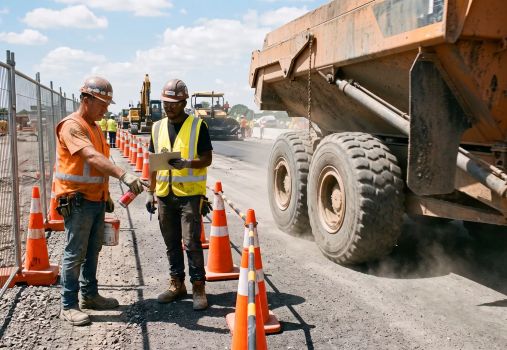
Most roadway contractors have a detailed traffic plan for the motoring public. Signs, cones and flaggers are carefully placed to comply with the Manual on Uniform Traffic Control Devices (MUTCD) and OSHA 1926 requirements.
Inside the cones, it’s another story. Dump trucks, loaders and pickups often weave through crews based on habit and convenience rather than design.
That’s a serious blind spot, says Robinson Vasquez, Safety Training Manager at the American Road and Transportation Builders Association (ARTBA), noting that 25% of roadway construction fatalities involve “our own equipment inside the work zone.”
That gap in safety doesn’t erase responsibility. Under OSHA’s general duty clause, employers must protect workers from any recognized hazard that could cause serious injury or death — and internal traffic is unquestionably one of them. That’s why contractors need Internal Traffic Control Plans (ITCPs) that spell out how company equipment and trucks move through the site and how those movements stay physically separated from workers on foot.
BUILDING AN ITCP
Because there’s no single federal template, an ITCP must be site-specific. Robinson urges contractors to literally draw the plan: “You have to do it by yourself,” he says.
A practical ITCP should define:
- Equipment routes. Designate primary haul routes for dump trucks and other heavy equipment, using one-way travel wherever possible to reduce backing.
- Worker-only zones. Establish dedicated paths and work areas for workers on foot, separated from equipment with cones, drums, barricades, temporary barriers or fencing.
- Delivery and staging areas. Identify where delivery trucks should queue and unload rather than allowing them to search for space in active work zones.
- Backing and swing zones. Mark danger areas behind trucks and within the swing radius of excavators, cranes and other equipment.
- Visitor access and parking. Provide designated parking and a safe route to the foreman or office that avoids active equipment paths.
Robinson describes an approach of “coloring” the site: “Tell workers, ‘These areas in red are for vehicles, for traffic, for heavy equipment. Avoid them.’ The idea is separating workers on foot from heavy equipment by creating some rules.”
CONTROLS THAT MAKE THE PLAN REAL
To move beyond paper, contractors need clear rules and visible controls:
- Minimize backing. Design one-way routes; require spotters or cameras for any necessary backing. A 2025 analysis of OSHA dump truck inspection cases found that 22% of fatal incidents involved backing, underscoring the need to reduce reversing.
- Train spotters. Spotters keep workers away from moving equipment and guide operators through hazardous conditions. Don't assign the newest worker to the role. Train spotters on proper positioning, standardized hand signals and when to stop work.
- Empower workers. Give any worker the right to stop equipment if backup alarms, lights or brakes aren’t working.
- Improve visibility. Use compliant, well-maintained high-visibility garments and adequate lighting for night work. Replace worn or damaged garments.
- Set and enforce speeds. Post internal speed limits and enforce rules prohibiting headphone and phone use in active work zones.
These measures are simple compared with the cost of failure. “We calculate that a single incident can cost around $200,000,” Robinson notes — and that’s before considering long-term human and reputational damage.
A 5‑POINT DAILY CHECK
Use a quick daily internal-traffic check to keep up with changing site conditions:
- Are today’s haul routes and equipment paths clear and understood?
- Are worker-only zones marked and physically protected where possible?
- Are backing operations minimized and controlled with trained spotters or technology?
- Are visitors and deliveries using defined parking and staging areas, not cutting through live work?
- Have any changes in routes, phases or equipment been covered in the morning huddle?
Too often, internal traffic control boils down to a familiar message: stay alert, keep your head on a swivel and watch for equipment. But awareness alone depends on perfect human performance, every second of every shift.

Robinson Vasquez
Safety Training Manager for American Road and Transportation Builders Association
A better approach is to design the jobsite so that workers and heavy equipment don't occupy the same space. As Robinson puts it, “The idea of controlling traffic inside the work zone to prevent runovers and backovers is basically separating workers on foot from heavy equipment. That is the logic that you have to use.”
Recognize Traffic Awareness Month by reinforcing safe driving habits and work-zone awareness. Read Make Road Safety a Year-Round Habit Starting with Traffic Awareness Month This August for practical safety tips and insights.