Benefits include improved productivity, lower total cost of ownership, safer operation and better asset management.
Hydraulic systems have powered off-road equipment for decades. Today, advances in sensing, computational speed, reliable edge gateways and cloud analytics are converting those systems from black box control systems into observable, optimizable and serviceable assets.
Digitalizing hydraulic components deliver tangible benefits, including reduced unplanned downtime, lower operating costs, improved productivity, new software- enabled capabilities and recurring service revenue for OEMs.
Replacing cab mounted hydraulic pilot controls with electronic interfaces enables better ergonomics, safer operator environments and simpler integration with autonomy and assistance systems.
The Evolution of Hydraulic Systems
The primary advantage of Hydraulic Fluid Power Control systems is their ability to produce high force density in a compact design. Early mobile machines relied on pilot-operated valves and direct mechanical linkages.
In the later 20th century, proportional valves, servo control and electrohydraulic actuation introduced closed loop behavior and smoother motion control. The emergence of CAN networks and centralized ECUs enabled coordinated machine control and basic diagnostics.
In the past decade, falling sensor and computer costs, ruggedized instrumentation and reliable mobile connectivity have enabled richer telemetry and edge analytics.
Looking to the future, there is an expectation of further modularization of sensorized hydraulic building blocks, widespread use of digital twins and remaining useful life models, tighter hydraulic electrical co-optimization for hybrid machines and expanded service models where uptime and outcomes become part of the commercial offer.
Why Digitalized Hydraulics Is Accelerating – Market and Technology Drivers
Several converging forces are accelerating the adoption of digital hydraulics. Regulatory pressure and emissions targets are pushing OEMs toward hybridization and energy optimized control strategies that require high fidelity sensing and coordinated control.
Customers want predictable operating costs, higher uptime and safe to operate systems, making condition-based and predictive maintenance attractive.
Technological advances, such as lower cost sensors, more capable edge processors and reliable mobile networks, have improved the economics of connectivity. The ascent of autonomy and advanced assistance systems makes precise hydraulic control and observability mandatory rather than optional.
Additionally, many OEMs are pursuing service strategies and data is the currency that enables outcome-based offerings.
What Digitalizing Hydraulic Components Means – The Technical Stack
Digitalization is a layered engineering endeavor in which ruggedization, functional safety and cybersecurity must be engineered into each layer rather than bolted on afterward.
At the foundation are sensors that provide measurements of pressure, temperature, flow, particle counts, vibration, acoustic signatures and precise position. Those inputs feed embedded ECUs that must be capable of deterministic closed-loop control for safety-critical functions while also performing local analytics and maintaining continuous connectivity.
In-machine networks such as CAN, CAN FD or time-sensitive Ethernet carry control traffic, while an edge gateway aggregates telemetry, enforces security and buffers data for cloud upload via MQTT or HTTPS over cellular/5G.
Cloud platforms provide time-series storage, fleet analytics, machine learning models for Remaining Useful Life and anomaly classification, dashboards and APIs that integrate with OEM systems and dealer tools.
Lifecycle tools for OTA updates, calibration, digital spare catalogs and service workflows complete the stack.
Benefits of Connected Hydraulics for OEMs and End Customers
For OEMs, connected hydraulics reduce warranty and service expenses by enabling early fault detection and accurate remote diagnostics, increasing uptime and productivity.
They shorten design cycles through data driven feedback from real use and they unlock higher margin product tiers and recurring revenues through predictive maintenance subscriptions and uptime guarantees.
Over‑the‑air updates will allow OEMs to deploy firmware enhancements, calibration updates and new features without sending a technician on site.
Fleet managers will gain tools to push consistent parameters across entire groups of machines, such as speed limits, geofencing rules or operator access settings.
Advantages and Trade-Offs of Moving Hydraulic Functions Out of the Cab
An area of recent focus has been removing hydraulic components from the cab and replacing them with electronic interfaces, such as joystick-by-wire, configurable pushbuttons and haptic systems. Such changes improve ergonomics, reduce operator fatigue, lower leak and fire risk and simplify cab layout for visibility and noise reduction.
Electronic controls also make it straightforward to log operator inputs, replay cycles and integrate with automation or assistance features without complex analog conversions.
There are also tradeoffs to consider. For instance, some operators like the tactile hydraulic feel. In addition, electronics require carefully designed redundancy, failsafe behaviors and functional safety certification.
Advances in joystick design now give haptic and force feedback to help replicate the hydraulic feel that operators prefer. With this approach, it’s possible to preserve or emulate tactile cues with haptics, provide selectable control profiles and validate failsafe modes extensively so operators trust the new interfaces from day one.
The costs of cybersecurity and operator retraining should also be considered. A good option is to adopt a phased, operator-centric migration.
The Importance of Cyber-Security in Digitalized Hydraulic Systems
Cybersecurity is a foundational requirement for digitalizing hydraulic components because connecting sensors, ECUs, gateways and cloud services materially expand the landscape of machines whose failures can cause severe safety, environmental and financial harm.
A compromise of hydraulic control or telemetry can lead to unintended actuator motion, loss of braking or steering capability, fluid system damage, data tampering that undermines predictive models, or theft and manipulation of operational data - outcomes that threaten operator safety, fleet uptime and OEM liability.
European laws such as the Cyber Resilience Act (EU CRA) raise the stakes by making “products with digital elements” (which explicitly covers hardware with embedded software and firmware) subject to baseline security obligations before they can be placed on the EU market.
Practically, that means smart pumps, sensorized valves, embedded ECUs and gateways must be developed and documented under a secure-by-design development lifecycle, include planned vulnerability handling and coordinated disclosure processes, provide post market support for updates and patches and supply the technical documentation demanded by market surveillance authorities.
The EU CRA sits alongside other regulatory drivers (including network and IT requirements like NIS2-style obligations for operators and sectoral rules and vehicle cybersecurity regulations) and established industrial standards such as IEC 62443, functional safety standards and, where relevant, automotive frameworks including ISO/SAE 21434.
This means manufacturers of digitalized hydraulic components must reconcile multiple compliance streams.
For OEMs and suppliers this regulatory environment increases supplier accountability and liability, tightens procurement requirements across the supply chain and makes capabilities like secure boot, hardware root-of-trust, PKI device identity, signed OTA updates, end-to-end encryption and robust incident response processes business imperatives rather than optional best practices.
In short, to access markets and unlock the value of connected hydraulics, it’s necessary to bake security into products, processes and supplier management from the start. There are significant benefits in treating security requirements, including compliance (EU CRA and related frameworks,) as design constraints and investing early in the people, tooling and evidence needed to demonstrate security across the product lifecycle.
Barriers, Constraints and How to Mitigate Them
Adoption faces several barriers, including:
- Harsh operating environments demand rugged components.
- Deterministic control needs require local ECUs for safety critical control.
- Fragmented standards and proprietary data models hinder interoperability.
- Retrofit economics must be proven for legacy fleets.
- Cybersecurity and safety certification add costs and development overhead.
Fortunately, mitigations are practical by designing components to relevant environmental standards, keeping core control local while using edge/cloud stacks for non-real-time intelligence, structuring pilots around clearly measurable ROI and embedding security-by-design with signed OTA and PKI device identities.
It’s important to invest in dealer and technician training so the organization can act on remote diagnostics. Without that capability, alerts don’t translate into realized uptime improvement.
It’s also advised to form a cross-functional team that combines hydraulics, embedded software, cloud analytics and cybersecurity expertise, as this blend is what makes a practical program succeed.
How Parker Can Enable and Accelerate the Transition
The digitalization of hydraulic components is a pragmatic, high value path to better uptime, lower costs, enhanced safety and new commercial models. Removing cab mounted hydraulics and adopting electronic interfaces is a pivotal enabler that must be addressed thoughtfully to preserve safety, operator trust and system reliability.
Parker’s hydraulic domain knowledge, systems engineering capability, state-of-the-art product technologies and global aftermarket presence give it distinct advantages to enable a phased, de-risked transition. The company can deliver smart hydraulic modules with a full range of embedded ECUs and valve drivers, simulation models of critical components and retrofit solutions with installation and calibration support.
Parker can also offer co-engineering services with OEMs, technician tools and training and standardized message sets to accelerate integration.
By leveraging Parker’s smart hydraulic components, advanced controls and system expertise, the off-road equipment market can meet the challenges of today and build the smart machines of tomorrow.
Visit Parker at Booth S81628
At CONEXPO‑CON/AGG 2026, Parker will demonstrate how its intelligent valves, pumps, and actuators, combined with embedded electronics, can enable high‑value health and performance data into OEM telematics systems, providing deeper insight into work‑function efficiency, duty cycles and remaining useful life.
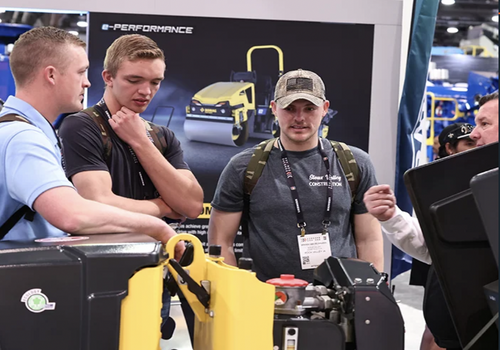
Attendees looking to turn high‑level trends like digitalization into practical machine designs are invited to visit Parker at Booth S81628. You will learn how motion, control and fluid‑management technologies integrate into real machines - from compact electrified platforms and advanced work‑function hydraulics to steer‑by‑wire safety architectures and digital cab concepts.
Parker engineers will be available to discuss integration options, co‑development support and system‑level optimization strategies tailored to specific machine classes and duty cycles. Whether the objective is to electrify a compact construction line, enhance automation or improve lifecycle sustainability, Parker will explore solutions with you that are ready to help define the next generation of off‑highway equipment.
Reserve time to meet with our engineers during CONEXPO‑CON/AGG 2026.