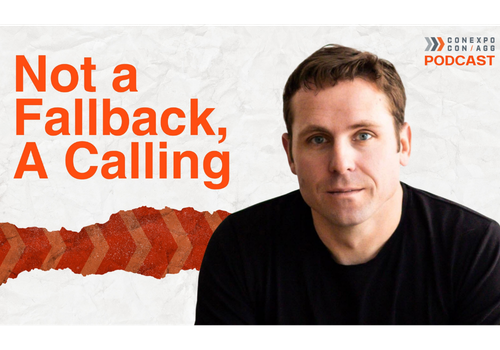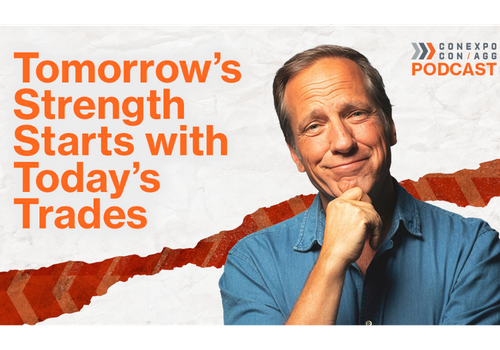



Construction business owners face a massive recruitment hurdle. Society has spent years telling kids that university degrees were the only path to success - a message that has created a culture where manual labor is seen as a ‘last resort’. Emmy award-winner, creator and host of Dirty Jobs, and America’s leading advocate for the skilled trades, Mike Rowe, joins the show to explain why this labor gap is a threat to national security.
Mike demonstrates why the construction industry must change how it markets itself to the next generation. Polished corporate videos often fail as young recruits can sense when they are being sold a lie. Contractors should focus on telling the authentic stories of their most successful employees in an effort that will help people see the wealth and pride available in a trade career.
Topics:
- The skilled trades recruiting crisis
- Why CONEXPO-CON/AGG showcases the heart of construction
- How apprenticeships and early exposure beat classroom hours
- Pride in craftsmanship and the art behind the trades
Watch now:
Listen now:
Listen on your favorite app: Apple Podcasts | Spotify | YouTube
Subscribe to the CONEXPO-CON/AGG YouTube channel to be notified of new episodes.
Join more than 65,000 industry peers who receive construction industry news and trends each week. Subscribe to CONEXPO-CON/AGG 365.
Episode transcript:
Taylor White: Welcome back, everybody, to the CONEXPO-CON/AGG Podcast. I am your host, as always, Taylor White. I would like to thank our sponsor, John Deere Power Systems, for supporting the podcast as always. I do want to remind everybody that CONEXPO, March 3rd to the 7th, is coming up. It is coming up super quick. We are scheduling stuff in the office, getting everybody down there. There will be millions of square feet, awesome exhibitors, and people. There are over 2,000 exhibitors, actually, to be exact. If you use the code "podcast20" for a discount, buy your tickets right now. Do not forget to go and do that.
But more importantly, today, folks, is a massive one. We are sitting down with the guy who made Dirty Jobs cool before it was cool: the voice behind Deadliest Catch, the founder of mikeroweWORKS, and one of the loudest champions for America's skilled trades that we have ever had, Mike Rowe. Mike, thanks for making the time today. Whether it is shining a light on the trades, handing out scholarships, or just telling stories that make us laugh and think, you have been changing the game for years, and I am thrilled to have you here.
Mike Rowe: Thanks, Taylor. It has been a privilege. It has been a weird road, for sure. I am still not precisely sure where it will lead, but it has been a blast to travel it.
Taylor White: Yeah, no, it is exciting. I think the road is a nice, paved highway right now for your life. But let’s dive right in. We are timing this perfectly because CONEXPO-CON/AGG 2026 is coming right up, and I know that the construction world is buzzing about it. You have been a part of this massive show before, correct?
Mike Rowe: I think my first CONEXPO was 2006, if I remember right. Maybe 2005. You know, they are every three years. All I know for sure is I have never missed one, and I have never had a bad time at one. I have had a weird time, but never a bad time. For me, it is always such a blast because I know CONEXPO is the official name of the event, but my first thought the first time I went there was, "You just could have called this Dirty Jobs 101." Everybody there watched my show. Everybody there had a story to tell me.
It was really, for me, I think, the first time in public that I realized how enormous this industry really was, how devoted the people in it really are, and how committed the companies that hold it together are. Just the money, the time, and the effort to put the best foot forward for the industry that literally makes civilized life possible for the rest of us. I just love it. It is like a carnival for sort of grown-ups.
Taylor White: Yeah, it is one of those things we always kind of discuss on the podcast as well, and you kind of nailed it. When people mention CONEXPO and they are like, "What is your favorite thing about it?" it is just like, first of all, you think about the scale and the size of it and just how big the show is. 2023 was actually my first time on the show, and I was blown away. You see hundreds of thousands of the construction community coming together in Vegas for the week, showing up. I think it is the people. You said that first: the people make it. Even for me, I have a YouTube channel on a very small scale compared to what you have achieved in your life, but it was so cool. Like you said, you are walking around and you see it is literally the demographic of us: the girls and guys that just love the industry. They love finding out what is new in it. I think that is just a really cool part of the show.
I am interested to know what companies at CONEXPO-CON/AGG do you think are paving the way for the future of construction, the industry, or the workforce, and why?
Mike Rowe: Well, look, I mean, this will sound a little mamby-pamby: I think all of them in their own way. Everybody is playing the cards they have, and they are all in kind of a lane. They are all engaged in a very company-specific endeavor. But more broadly, we are all in this giant industry together.
The thing that struck me, Taylor, the first time I went, and it gets me every time, is that it is such a weird mix of characteristics and talent. On some level, virtually everybody you see there is still an eight-year-old digging in the dirt. They are still gobsmacked by the fun of assembling a thing and creating something where there was nothing: just the joy of building and fabricating. On the other hand, you have got some enormous technical brains and some really shrewd businesspeople who have made some super calculated decisions to move and shape.
The first company that brought me in was Terex. They make these cranes, and at the time, I think they were building Dubai. Eighty percent of the cranes in the world were in Dubai, and a big chunk of those cranes were made by Terex. Most people just walking around living their life, they have never heard of Terex. They don't think about the role of a crane in the larger topography of shaping a landscape, a nation, a country, a town, or an individual building. You just don't think about it.
Caterpillar - Cat has brought me in probably five times. They are such a leader in the industry, and they always want to put their best foot forward there. They built a whole stadium the last couple of years and sponsored this heavy equipment challenge: "Let's find the best operators."
Taylor White: That was cool.
Mike Rowe: Yeah. And so, I just think there is no better convention on the planet that combines the enthusiasm for the work, the passion for the work, and just the scale of it. When I said before it was like a carnival, I meant to say a midway. It is like walking down the midway of a giant state fair, except instead of somebody standing there waiting to guess your weight or have you throw the darts and pop the balloons, it is somebody introducing a piece of tech that five years ago we couldn't have imagined. But there it is. It is going to be consequential. That is the word. Everything at CONEXPO is consequential. The stakes are high. And Vegas, of course - I mean, you can talk about CES as a convention, you can talk about the Boat Show; that is a pretty big event, very engaged audience. But nothing comes close to the construction exposition. You kind of have to see it to believe it.
Taylor White: It is one of those things where you are right, having it in Vegas is perfect. You get that demographic and those people. Like you said, too, you have people at the Trimble Sitech booths that are GPS gods, and their minds work a certain way. My mind certainly doesn't work that way. Then you have guys that are just going there to be like, "I want to see a bulldozer, and I want to see the biggest bulldozer, and that is cool." Everybody just makes it work there.
There is so much stuff for the future as well there, and I think that is what is really neat about it. It is like a big area to even just talk to people about what is coming and what is looking ahead. I like that conversation a lot because I like talking about some of the things that kind of hold us back and how we fix them. So, I would be interested to know: what do you think is one misconception about the skilled trades that you wish every contractor would stop repeating, and how does it hurt their ability to recruit the next generation?
Mike Rowe: That is an interesting question. I don't really know if there is one thing that contractors as a group are guilty of perpetuating. I think most people are subjected to the inertia in their own business. So, you get used to doing things in a certain way, and there is a lot of pressure to keep doing that thing that way. Thoughts are not much different than actions. Once you think about a thing in a certain way, it is like a little rut that you start to make. Then pretty much that is how your thoughts run, and then that is how your actions run, and that informs your expectations. That trickles into how you hire, and that trickles into your company's identity.
This happens in every industry. It is why the local news all looks the same. Everyone sits there and talks like this because that is the way they do it. I think any industry today, especially, is challenged by inertia and entropy and all that stuff. But you better get up to speed with the fact that there is a new sheriff in town, and his name is Artificial Intelligence. It is changing everything, and it is going to require us to think differently about the definition of a good job. It is going to require us to think differently about the role of our own industries.
I mean, I can't overstate it. The myths and the misperceptions and the stigmas and the stereotypes that have always conspired to make it difficult to recruit in this industry - they are still with us, but they are being challenged and changed in ways that go beyond better PR. I think the calculus, I think the math that is going on right now, we have never seen before. For every five tradespeople who retire this year, two will replace them. Five out, two in. It has been that way for over a decade. You don't have to be a math major to look at that and go, "Alright, that ratio is not sustainable."
And yet, this industry has borne the brunt of it. The workforce is aging; people are retiring faster than they used to. But we haven't made a persuasive case for the work that the industry does, and therefore, the next generation coming up, they are both diminished in terms of the total size, but they haven't been persuaded. Our industry hasn't taken the country by the lapels and shaken it and said, "Hey, look at the jobs that exist in this company. Look at the opportunity that exists here. Let me introduce you to a couple of my superstars."
Caterpillar wouldn't mind me saying this; I have said it to their CEO on more than one occasion: "You guys have an opportunity to make a rockstar out of any number of employees who have prospered and thrived as the result of mastering a skill that is in demand and then going to work." We need to affirmatively lean into our own success stories, and then we need to tell them: proudly, unapologetically, not through the lens of marketing and PR. I don't need another campaign that has been focus-grouped and tested because today, people entering the workforce, this current generation, their bullshit meter is finely tuned. They know when they are being marketed to. Whether it is social media or whether it is billboards, outdoor advertising, my answer to your question is, collectively, we need to make a more authentic and more persuasive case for the opportunities that exist in the industry. We have to really lean into it, and we have to get ahead of it because right now - and look, I know you know this - it is a knife fight in a phone booth to recruit.
I was in a data center last month in Plano. I met three electricians, all under 30, all making north of $250k a year. No debt between them. And here is the craziest thing: all of them had been poached three times in the last 18 months from other similar projects. That is bad news for the industry from a supply and demand standpoint, but from a recruiting message, those guys need to be on billboards. That is what my foundation does. How can I tell that guy's story? And so, how can I get a parent or a guidance counselor to pay attention and say, "Holy crap, man, that guy is making a quarter million a year with no debt, second kid on the way, he is happy, he has got as much overtime as he wants"?
Those stories are real. We have got to tell them because at this point, it is not just a question of successful recruiting for this company or that company or maybe better opportunities for this guy or that woman. You are getting into the world of national security here. You are talking about our infrastructure. Jensen Huang and Larry Fink, I just saw them; they did a thing in Davos. They are calling what is coming the greatest infrastructure build-out in the history of the world. Are we ready for it? Is the construction industry ready for it? The answer is an unqualified no. And the reason has nothing to do with enthusiasm or technology; it is workforce. That is what it is, and we either get ahead of it or we don't.
Taylor White: I think you nailed it. It is like people, when they think of trades, they think "dirty, bad trades, last resort." And what you said about doing it authentically, that is what kind of started at least myself with social media. I am a third-generation construction company owner. My biggest thing was showcasing what we do on social media but doing it so much differently than what everyone else was doing. I showed myself out there; I just attached a GoPro to myself and I showed the work. I didn't bleep out the f-bombs and the cursing on site and the double-double coffee breaks and the guys hacking darts. It is like, this is what the industry is. It is not double-doubles and hacking darts, but showing it in an authentic way and not doing ads that are elevator music, corporate, somebody that, you know, we are like, "Okay, sit here and put plans on your desk, and we are going to look at this and take a shot of that." It just doesn't work. And like you said, the new generation - I always say, don't bullshit a bullshitter. When you see something and the new generation sees something, they are able to tell right away, like, "Okay, yeah, this is BS."
And you made a really good point with AI because I am curious what you think about where AI fits into the industry. I use Chat every day, especially with like emails and responses because I am good at creating hype and growing a business, but I am not a university major; I don't have the brain for that. So sometimes when I get an email, I use Chat in that way. Where does AI kind of fit into it? But I kind of want to also touch on, when we talk about the new generation, the new workforce - and I wrote this in my notes when you were talking - do they want to work? Do they want to work hard? Because that is an important thing to talk about as well, right? Because I know a lot of guys that are 60, 70, 50, 40 that don't want to work as well, too. And a lot of people say this new workforce doesn't want to work. So, is that a thing just an old guy says, or is it true?
Mike Rowe: Well, two things can be true at the same time. It is a thing an old guy says. It is also true. But it is also broad. And here is the challenge in my view: we have got a macroeconomic challenge with global implications, and so it is almost irresistible to not paint with a broad brush. We want to say things that resonate with the fat part of the bat and we want to be relevant to large numbers of people. But it still won't work. That desire is the same desire that got us into this fix in the first place, when we talked as if a four-year degree was the best path for the most people.
And we got behind a push for higher education, which, by the way, to be fair, I think we needed in the early 70s. We needed more engineers, we needed more doctors, we needed more people going into higher ed for these jobs. But in our attempt to make a more persuasive case for that road, we used this road - the construction industry and the skilled trades - we used it as a cautionary tale. "If you don't do this, you are going to wind up here."
Correct. Now, at the same time, we did another truly boneheaded thing, which was take shop class out of high school, which removed from sight all optical proof of the very existence of these jobs. So, CONEXPO is the polar opposite of that. CONEXPO is the entire industry in your face, without apology. In a smaller scale, that is what shop class was to high school kids. And I am not even talking about the high school kids who took shop class. I am talking about the kid who was just walking from English to math and stuck his head in the carpentry shop and saw something that looked like real work, or the metal shop, or the auto shop.
Work was sort of filtered into K-12 from the jump. But we took all that out, and then we told a whole generation of kids they were screwed if they didn't get their certification through a university. And then we freed up a bottomless pile of money and put incredible pressure on people to borrow whatever it took to go down that road. And then we asked ourselves, "Geez, how did college get so expensive?" Well, how could it not? How could it not? So, all of that is just kind of a preamble to why today we have got $1.8 trillion in student loans still on the books. We have got seven million open jobs, most of which don't require a four-year degree and are in your industry. That is real.
Interestingly, we have got 6.8 million men, to get to your question, who are not only not working, they are not looking for work. That has never happened, dude. Not in peacetime have we had that many able-bodied men just sitting back and going, "Nope, I am out." This is a super complicated topic, and it is kind of like a world war that has to be fought on multiple fronts. A lot of it is beyond my pay grade. I do believe it all has to be dealt with. And maybe, back to your first question, that is why I keep coming back to CONEXPO. It is a bit like going to church. If you are a believer and you are already converted, you don't really need to hear the sermon, but it is still important to be around people who get it, who see the world the way you see it.
And so, all of these things are at play. Sorry to evade your question. Let me answer it directly: is this generation willing to work? That is your question. The answer is impossible because I can't answer you without painting with too broad a brush. I will tell you, in my view, it is like a memo has gone out, and a lot of Gen Z - and this is good news - they are getting it. It is like turning a tanker around. But my foundation has been around 17 years, and we award work ethic scholarships precisely because we want to elevate and magnify a work ethic and some modicum of personal responsibility and delayed gratification and a decent attitude. We still care about those things. This year, we got ten times the applications that we did a year ago. So, anecdotally, in my little world, in my lane, we are moving the needle. I know we are doing something right. We awarded over $5 million last year in work ethic scholarships. I could have done twice that had I known the interest would have exploded the way it did.
And part of the reason is back to AI. The energy industry is the first layer in this AI cake. You have got chip makers, you have got the cloud world, you have got the actual companies up top that employ the AI; that is where most people think. But when you think about the jobs that are going to be created in the process of baking this cake, it starts with energy. The energy industry is hiring 24/7 around the clock right now, and the construction industry is right there adjacent to it. And then you go up to data centers and that, to my earlier point: they are poaching electricians and plumbers. You need a lot of plumbers in a data center. There are giant tanks of water that are cooling these processors and so forth. It is all tangled together, Taylor. It is all of a piece. And while it is tempting to say yes, the work ethic is fractured because I believe it is, I believe there is still a lot of confusion about the reality of getting up early and staying late and taking a bite of the shit sandwich when it is your turn and paying your dues and doing all those things. I think those are still very much in demand. But I also think the sheer demand itself and the aforementioned demographic realities of what we are dealing with is going to force the country to take a deep breath and look at this thing as the Manhattan Project that it is. This is a massive infrastructure build-out, and it is not going to happen without skilled labor.
And that simple truth has informed the C-suite and a lot of elected officials. I will be in the Pentagon next week for a couple of days talking to people with grown-up jobs about the absolute criticality of reinvigorating the skilled trades. Sorry for the lecture, but it is a complicated issue, and it does touch on - obviously, everybody listening to this has skin in the game - but so, too, do the CEOs of companies you wouldn't expect, like Wells Fargo, like BlackRock, like Blackstone, like Fisher Global Investments, like JPMorgan. They are all paying attention, and it is going to be super interesting to see how it plays out.
Taylor White: Yeah, and it is funny that you mention people having skin in the game because what I think when you talk like that as well, too, is like, yeah, I believe that the best marketing scheme ever - and I call it a scheme, but you know - is "Hey, you have got to go to university and get a degree and you have got to do this," and they look down on the trades. It sucks because I feel like Gen Z is the generation, or even Gen A coming up now, where if something bad happens, it is someone else's fault. But it is also like they grew up their whole lives being told, "You have to do this, and if you don't do this, then you do that."
Mike Rowe: We are the clouds from which the snowflakes fell.
Taylor White: Exactly. 100%. And my next point touches on that because I think as a business owner, I would highly advise this young generation - much like you have your foundation - on a very, again, much smaller scale, I do an annual scholarship at our local high school, the one that I went to, in my grandfather's name. We give $10,000 to a student that wants to pursue the trades every year. They always say, "What is the best piece of advice you could give me?" and I am always like, "Be at the right company." Because that is so important as well, too.
And I think as business owners - because a lot of business owners listen to this podcast as well, too - what I am going to ask is: what would happen if every contractor that owned a company treated hands-on skill development - so developing the young people that are coming to work for them - with the same urgency as they do on safety, as they do to cover their own liability? You start a company and it is like, "Okay, we have 14 days of training, and this is how you lock-out, tag-out, this." Safety is very important; don't get me wrong. But after that safety orientation, there is not much more skill development going on at the company. So, being at the right company is very important. What would you say to the contractors listening and being like, "Treat skill development with the same urgency as you do with safety"? What would happen to the workforce if we focused on that?
Mike Rowe: Well, more broadly, what would happen if you told the truth? Earlier you were talking about your attempts on YouTube to portray an honest job site. That is really what Dirty Jobs was, but through the lens of a different industry. It is probably worth a quick sidebar because you have got to remember: in 2003, there was nothing on TV. I mean, there was no reality TV at that point. I think Jesse James was building motorcycles, Monster Garage maybe. And Survivor was on, some reality competition. But there was nothing like Dirty Jobs.
I wanted that show to be honest, and it was a very difficult time because TV is fundamentally dishonest, and production really is the enemy of authenticity. There is an old expression: if you are cutting, you are lying. If you are editing, you are lying. Once you put your hands on a thing and run it through your worldview, your process, you are, well, you have your hands on it. How to avoid that in my world? The only way I could think to do it was to refuse to do a second take, which I did, and then insist on having a documentary camera film the making of the show, which I did.
I promise I will make this relevant. What that allowed me to do, as we were delivering the show to the network - who, by the way, was horrified - the network was horrified by Dirty Jobs' success because it is a great example. Like, you are a business owner. What do you do when your customers want something you don't want them to want? What do you do? You either tell them to beat it, you either ignore it, you put your head in the sand, or you give them what they want anyway, and you realize, eventually, "You know what? I was wrong. I was wrong about what I thought my business did. I was wrong about who I thought my clients are. I missed something."
Well, with all due respect to my prior employer, the Discovery Channel had missed something in 2003. They thought authenticity existed because experts like Jane Goodall and David Attenborough and Jacques Cousteau occupied their airwaves and that those people talked with such authority that you would get to the truth that way. Dirty Jobs was a whole different premise. Dirty Jobs was, "I am not the authority, and neither are you, Discovery. We are just ciphers. We are just avatars." The authorities are actually the people that we were profiling, for better or worse. And I am not going to give them a second take because my goal is not to get it right. My goal is to show you the truth of the day.
And so, whenever you see me cut to that behind-the-scenes camera in the show, which is a lot, it usually comes at the expense of OSHA, or the EPA, or the Discovery Channel themselves, or the owner of the business I am there profiling, because something happened that wasn't according to the book. And the pressure to not let humanity see your ass, don't show your mistakes - that pressure is enormous. And it exists in the TV industry, I think more than any other industry, but it certainly exists in the skilled trades, too.
Safety is not first. No. Go to a job site. If safety were first, there would be no one on the job site. We would all be home bubble-wrapped in our altered-states tubes. If safety were first, the speed limit wouldn't be 55; it would be 15, and cars would be made of rubber, and we would all wear helmets, and left turns would be illegal, and so on. Safety is not first. But to make that point on TV is heretical. But I had to make it. So, we did a special years ago called Safety Third. And talk about breaking some eggs, man. We just showed the honest truth of work.
As a part of that, I made the point that on Dirty Jobs, nobody got hurt for the first season. My crew, we were on the most hazardous job sites on the planet, from fish boats to the top of the Mackinac Bridge, painting and welding, all of it. Nobody got hurt. Second season, nobody got hurt. And during those first two seasons, Taylor, we all sat through, I will say, 50 mandatory, compulsory safety sessions: lock-out, tag-out, confined space, the checklist. And I was happy to because I wanted to live, and we were scared, and we were all out of our element. So, we all paid attention. By the third season, everybody on my crew got hurt. I broke two fingers, lost my eyelashes in a bizarre forge mishap, we had ruptured eardrums, we had cracked ribs, I fused my contacts to my eyes. Fortunately, nothing really terrible, but everybody got banged up and stitched up.
And the reason was simple. The reason was, as we sat through yet another compulsory safety meeting, I glanced around the room and half my crew was asleep, and I was nodding off, too, because it just simply didn't matter anymore. They had worn us down. It was like the teacher in Charlie Brown: "Wonk, wonk, wonk, wonk." We through all the "Safety First" nomenclature and dogma. Safety First signs everywhere we went, safety officers everywhere we went. The unintended consequence of all that resulted in me and my crew coming to the conclusion that somebody else cared more about our well-being than we did. That is the unintended consequence of safetyism. That is the unintended consequence of putting safety before everything else. It leads to a kind of complacency.
And that is the real enemy. And that is what happened to us. And I will tell you something else, too - this always ruffles feathers, but it is the truth. This special happened - I was on a roof one day patching a hole with my crew, with a bunch - it was a hot tar roofing episode, and we were on a steep slant, and we were about six feet off the ground. And we were doing the work, and the guy ran over to stop us to put on a harness. Now, I am all for a harness; I wear harnesses every day. But the lanyard on the harness was six feet long, and it was made of stretchy material. I am six feet off the ground, man. So if I fall, I am going to hit the ground just as hard as I would if I wasn't wearing a harness. Now, I pointed this out on camera to the Truth Cam, and the safety officer just shrugged and said, "Safety First. You got to wear it."
And this happened all the time. All the time. I remember working in a drainage ditch in maybe 18 inches of water. Guy runs over, makes me put on a life jacket. And I am like, "Dude, it is two feet of water." He says, "Safety First." So, when you fall in love with compliance, that doesn't mean you are out of danger. Just because you are in compliance doesn't mean you are out of danger. And that makes OSHA crazy, it makes Safety Firsters crazy, because their job is to comply.
So, I thought there was a real interesting opportunity for an honest conversation about the importance of safety on the job, and that is what Safety Third launched. Not to put too fine a point on it or blow my own horn, but after 10 years of taking endless crap for it, the International Safety Association - and I am holding up my major award right now for those of you who aren't watching - gave this to me last year. And they estimate that the whole Safety Third approach - which, by the way, led to all kinds of actions at NASA and at major railroads over the years - they reckon it saved over 100 lives.
So, what a rant that was, but my point is: the unintended consequences of doing things right are just as dangerous to this industry as the intended consequences of not doing things wrong. And so, it just means that there has got to be a measure of common sense on the job site, and regular people have to be encouraged to point out the truth, even when it is inconvenient or non-compliant, because we are living in a fast-changing environment. And if we want to get at the truth of a thing, well, you might ruffle a few feathers.
Taylor White: Exactly. And that is the question I wanted to ask you, like: okay, you have been in so many training sessions, safety this and safety that. I bet you it would be disgusting if you tallied up all the hours that you spent in a classroom listening to, "Wonk, wonk, wonk." But my question to you is: for many companies, training is, "Okay, follow Joe around," and "Okay, sit in mandatory 14 hours of class about this." If you could kind of redesign the training system for safety, or even just in general, the training system that companies use, what is the first thing that you would delete, and what would you build in its place?
Mike Rowe: I think the first thing I would challenge is the word you just used: "hours." I would take the time rubric and say, "Why? Why are you equating competency with time invested? How is that meritocratic, and how does it accurately reflect the skill set we are all hoping to bolster?" I can see it if there is no skills gap, if there is no rush to finish the project, if there is no Manhattan Project, if we are not competing with China - okay, maybe we can embrace some sort of training rubric that is focused on time. But we are not in that world. Time is not our friend. We need to train people in ways that reflect their competency, and we need to matriculate them into the workforce the minute they are competent, not the minute they are old, not the minute they are compliant or qualified by some time-based metric.
I was in a school called Central Tech in Drumright, Oklahoma, right in the middle of the state. One of the best trade schools I have ever seen. I was there to do a piece on their welding program; a couple of scholarship recipients from my foundation were working out there, and they are just doing amazing things. I didn't realize there was a nursing program on the other side of the campus. During lunch, I walked over there and started chatting up some of the nurses and some of the instructors. And I asked the instructor - there are about six or seven of us standing around in the hallway - I said, "So this is a two-year program, right?" And they all laughed, and they said, "Sometimes." Like Carol over there, it is probably going to take two years and two months, at which point Carol kind of gives everybody the finger and everybody laughs. Sharon will be done in nine months. She comes in 14 hours a day; she is a monster. This one is going to take a year and two months.
They had totally thrown it out because the nursing shortage is so acute in Oklahoma that they can't afford to sit around and build schools that make money based purely on time. So they just threw it out the window. I reckon something like that probably needs to happen in this industry. We just have to think differently. I still think the apprenticeship model is the best. I have yet to see a better solution than real on-the-job training. I would just say it needs to start earlier. When I was in school a century ago, they called them field trips. They would take you to a construction site. You have just got to get kids in front of the work at an earlier age. I am not saying toss them the keys to a backhoe, but I am not saying don't do that either. I mean, the sooner the better.
My buddy runs Montana Knife Company, and he came up in the construction space. And he has got eight, nine-year-old kids on heavy equipment. He is with them, but he is teaching them. I just think it is so important. One of the most popular videos of all time back when VHS videos were a thing - again, this is way back in the early 80s - was called Under Construction. All it was was a dad went out with a video camera and he filmed big machines doing big work because his kid was fascinated by it. They sold millions of copies because kids are fundamentally fascinated by it. It is why Lego and Lincoln Logs were a thing. It starts as early as it can start. And when it really comes time to teaching, I think you have to follow the money. Who is getting rich as a result of the way we are teaching skilled trades? And there is nothing wrong with getting rich, but if we are going to try and fill the pipeline faster with competent skilled talent, I kind of feel like we just need to take a whiteboard and start from scratch.
Taylor White: Yeah. What is some of the best training that you have had in your life? That you walked out of and you are like, "Okay, this, that was cool. That was a good way to learn," or "That was a really valuable course"?
Mike Rowe: I don't know how applicable your audience will find it, but the funny thing about me - or maybe the ironic thing - is I am living proof that the handy gene is recessive. I desperately wanted to follow in my granddad's footsteps. That was a guy who could build a house without a blueprint. He was amazing. And I worked as his apprentice in my teenage years. And it is a bitter lesson: just because you love something doesn't mean you can't suck at it. And it is not that I sucked at it, it just didn't come easy to me the way it came easy to him. And it was my granddad who told me, "Mike, you can be a skilled tradesman, just get a different toolbox."
So my answer to your question has to do with my own trade. And it took me a while to get there. I learned to sing, I learned to act, I learned to write. And then by the time I was 22, I was narrating projects for the National Geographic. My voice changed early on, and the people who were hiring me thought I was much older than I was. I had no idea what I was doing, but I was walking into a recording booth alone with a script. And the first time I remember reading a script and then listening back to it, and then seeing the finished product on the air and having a chance to listen to myself, not in real life but through a lens on a camera, through a speaker - it was transformational. It just completely changed the way I thought about narration at the time.
Now, some things would happen later that made me rethink it again. The crazy thing about Dirty Jobs was I was 42 when that show hit. So I had freelanced from 21 until 42 impersonating a host. I narrated everything. I did hundreds of commercials, infomercials. I was on sitcoms, I was in movies. I sang in the opera for eight years, believe it or not.
Taylor White: Really?
Mike Rowe: Oh yeah. I looked at the entertainment industry the way my granddad looked at your industry. And his philosophy was: don't ask me if it is better to be a welder or an electrician or a pipefitter or a plumber. It is better to do it all. It is better to understand all of it, because if you are going to be in this world, you are going to be weighed and measured both on your work ethic but also on your flexibility and your versatility. So be curious about all those things. My pop only went to the seventh grade, but by the time he was 30, he had his own electrical contracting business, and he was legend.
So I tried to be like that in my own crazy weird trade world. That is why I did as many things as I could. To answer your question, the only training that ever worked for me was - I mean, I had some great teachers, and I am a pretty good mimic, and a lot of competency is the illusion of competency and that is how we learn, by imitating. So I had some good teachers along the way, but nothing compared to watching myself on TV or listening to myself. That level of personal self-evaluation is really important.
And I don't know if there is a corollary. I think there might be. When I think about guys on Dirty Jobs, I remember a guy driving me around a town. He was a mason, but he also did a lot of facade work and a lot of really intricate, Italian-inspired work. He could make a gargoyle and put it on a building. And we are driving around town, and he is like, "Look at that building, yeah, I did that one. And I did that one." And I saw a tear in his eye at one point. I had a cameraman in the back, and I had a camera too, because I shot a fair amount of that show myself. And I said, "Hey, pull over for a minute, man. I want to ask you about this." And I had a really honest conversation in the cab of an F-150 with a hardened man in his mid-50s who had lived his whole life in the trades but was emotional because he is looking at his handiwork. He is driving by it; he can see it. We got out of the truck and we went over, and I put my hands on it.
That is as close as I can get to an answer to your question. When you can take a skilled tradesman and watch them looking at and evaluating the work of their own hands, it is very powerful. And it is artistic. And that is probably an important point to make that we haven't hit before: before they took shop class out of high school, it was called the Industrial Arts. The first thing we did was we took the art out of the industry, and then we just called it Votech. We hyphenated it. Once you hyphenate something, man, you are not on a road to anything good. And then we just called it shop, and then we walked it up behind the barn and shot it. But it started with the removal of the art.
And so, I think there is still real artistry at the Construction Expo, and I think the tools that you see there are the tools of artists. And maybe a better answer to your earlier question is something the industry can do is challenge its members to find the artist within and somehow be true to that. You are not just making little rocks out of big rocks. You are not just slogging through a trench. You are doing a really important thing, and the amount of pride, the amount of care, the amount of giving a shit that is applied to it - that is not on a checklist. That is a thing that is 100% in your control. I choose to control it, and I certainly challenge the people that we help on my foundation to do the same thing. And I would challenge the industry to do likewise.
Taylor White: Yeah, it is a lot of passion, right? Like, passion is kind of what you are describing, too. It is like that guy you were driving around with in the F-150. He had passion and love for what he did. I think that also makes our industry so cool: in the trades, it is so cool. I am the culprit of that, too, right? I like driving around with my kids and my wife, and I am like, "You know what? We built that house. Yeah, we did that dealership, too. Yeah, we did that." It is a sense of pride, and it is really cool. I am sure the same with you and your industry: your voice lives on, and your work lives on. I think that that is what is really also cool about the trades as well, too - is that it is something that needs to be told more, that it is like the work that you do will be shared for tens of years, hundreds of years plus, which is forever, which is really cool. I think that is one of the cooler things about our industry.
Mike Rowe: It is cooler than cool. It is a blessing. But I think it is also important to state, too, that there is a big chunk of your industry - think of the foundation guys, think of the steelworkers, think of the rod busters. I did a story down in Florida on a bridge.
Taylor White: Yeah, I remember that episode. I was a huge fan of your show. Me and my dad watched it all the time. That was an insane - I remember that one. That one stands out. It is funny you said that.
Mike Rowe: The reason I wanted to do it - way back in the beginning, one of the very first episodes that I realized struck a chord was a sewer inspector. And part of the reason why I think it resonated with people is that no one knew this guy exists. No one sees his handiwork. He is 10 feet underground hammering out rotten bricks and putting in new ones to keep the entire sewer system viable so the streets don't collapse and run with crap. It is a really important job, and nobody has any idea that he is doing it. That is important. Shining a light on people who are out of sight and out of mind was a big mandate of the show.
But the steelworkers were different in that it is just so poetic. They build these amazing structures with thick rebar, and it is like a Trojan horse. These giant, soaring edifices made of steel, and when they are done, it is beautiful to look at and artistic in every way that a thing can be both masculine and beautiful. Hard, beautiful work. And there it sits. And then the concrete guys come in and bury it for all time. Now, what do you say to that rod buster, that steelworker? If I am riding around with him in the F-150 and he is showing me what he has worked on, well, he is going to point to an overpass, and all I am going to see is concrete. And he is going to say, "Now under that is a skeleton, and that skeleton allows our entire highway system to exist. But you can't see it, and when you drive over it, you won't think about it because there is nothing to see. And yet, you remove it from the equation and the whole thing collapses."
So yeah, it is not an easy thing to say, "Take pride in this thing you have done that is now invisible and unknown to the very people who benefit most from its existence." My job on the show was to tap the country on the shoulder and say, "Hey, get a load of that. Get a load of him. Get a load of her. Look what they built."
Taylor White: I think that is why there was obviously so much success with it as well, too. Honestly, Mike, it has been an honor to chat with you for the last hour. I know that you are a busy man, and I am really excited to see you at this year's CONEXPO as well, too, March 3rd to the 7th. I appreciate you coming on today and dropping all the knowledge that you did. I mean, I could go on and on. It is a really smooth conversation with you. So thank you very much for coming on today.